
Last updated November 18, 2026
 Architectural shingles
 Metal roofing
 Tile roofing
 GAF
 Owens Corning
 Flat & low-slope
Free roof inspection with deck photos before we talk money - GAF and Owens Corning certified installation
Roof Repair Maintenance Schedule: What to Do and When
The most valuable maintenance task for a Henderson roof costs nothing and takes fifteen minutes: after the first monsoon rain of the season, walk to your downspout discharge and look at what washed out. A handful of dark granules in the splash block tells you your shingles are aging evenly. A small drift of sandy grit, or a sudden uptick from last summer, tells you something changed up there. Henderson doesn’t punish roofs the way the Pacific Northwest does. We don’t fight constant moisture; we fight drought, heat, and the violent rain that follows. That means your maintenance calendar shouldn’t look like a generic “inspect twice a year” checklist pulled from a national website. It should be built around what actually happens to a roof in the Mojave, month by month.
Quick Answer
A Henderson roof needs three scheduled checkpoints a year: a pre-monsoon inspection in May or June, a post-monsoon inspection in October, and a light winter look after the cool-down. Of those, the October window matters most because it’s the best time to schedule any real repair before cooler weather settles in. Granule tracking, flashing checks, and tile inspections between those checkpoints do the rest.
Styles & brands we work with
- Architectural shingles
- Metal roofing
- Tile roofing
- GAF
- Owens Corning
- Flat & low-slope
Table of Contents
- Why a Henderson Roof Needs Its Own Calendar
- Pre-Monsoon Checklist: May and June
- Post-Monsoon Inspection: October
- The Annual Tile Inspection Protocol
- Tracking Granule Loss Year Over Year
- Maintenance Tasks That Protect Your Warranty
- The Winter and Cool-Down Check
- When to Call a Professional
Why a Henderson Roof Needs Its Own Calendar
Henderson sits in a climate that most national maintenance guides get wrong. The advice to “clear moss and check for standing water” is written for the damp Northwest. Here, the real stressors run in a different order. Summer surface temperatures on a dark shingle roof can climb well past 150°F, and the material expands and softens under that load for months. Then the monsoon arrives, and a roof that’s been baking and drying for ten months gets hit with sudden water. That rain-after-drought sequence is the specific event that fails flashings, opens caulk joints, and finds every weak pipe boot on the roof.
Our technicians have up to 10 years of experience on local roofs, and the pattern they see repeats every year. The failures that matter in Henderson cluster around two moments: the first heavy rain of July and the thermal cycling that follows. Neighborhoods on the higher ground toward Lake Las Vegas and the foothills near Anthem see more wind-driven rain, while older tracts closer to Water Street tend to have shingle roofs that have already been through a couple of decades of this cycle. The calendar below accounts for both.
Ridgeline Roofing Co. is named for the ridge, the line where a roof proves itself. If you want the full picture of what we do locally, start with Ridgeline Roofing Co. Henderson home.
Pre-Monsoon Checklist: May and June
This is the window where you prepare for water, not heat. Do it before the first storm, because once the rain starts, you’ll be scheduling behind everyone else on the block.
- Check the flashing at every roof-to-wall transition. Heat and drought shrink the sealant around step flashing and counter-flashing. Run a hand along each joint and look for gaps, lifting, or cracked caulk.
- Inspect all caulk joints and sealant lines. Any bead that has pulled away or turned brittle needs attention now. A dried, cracked joint is a direct path for monsoon water.
- Examine pipe boot seals around plumbing vents. The rubber collar on a pipe boot hardens and splits under UV and heat. These are among the most common leaks we see after the first storm in Henderson.
- Clear the valleys and gutters of debris. A clogged valley during a sudden heavy rain pushes water sideways under shingles.
- Look at the attic after a hot day. Staining or daylight in the sheathing tells you there’s already a breach.
If any of these checks turn up something you’re not sure about, that’s exactly what a free second opinion on a written estimate is for. Call (833) 691-6717 and we’ll take a look.
Post-Monsoon Inspection: October
October is the most important checkpoint of the year, and it’s the one most homeowners skip. After a full monsoon season, your roof has just been through weeks of thermal-shock cycling: hot days, cool rain, rapid contraction, repeat. That cycling is what causes hairline cracks, loosened fasteners, and small punctures to finally open up. This is the moment to catch them, because a repair done in October sits finished and settled before the cool-down. Wait until December and you’re working around cooler, less cooperative conditions.
Here’s what the October walk-through should cover:
- Re-check every flashing joint and caulk line you serviced in spring, since thermal cycling may have reopened something.
- Look for lifted, curled, or missing shingles, especially on south- and west-facing slopes that took the most heat.
- Scan the ceilings and attic for new water staining, which often shows up days after the last storm, not during it.
- Confirm gutters are still fastened and draining, since monsoon debris and flow can loosen hangers.
In our experience, the repairs scheduled in October are consistently smaller than the same problems left until spring. This is also the best window for any Roof Repair in Henderson before the cool season.
The Annual Tile Inspection Protocol
Henderson has a large inventory of tile roofs, and tile has a specific failure mode that shingles don’t: cracked field tiles from foot traffic. Every time an HVAC technician or a satellite installer walks across a tile roof, there’s a chance a field tile cracks underfoot. A single cracked tile can let water reach the underlayment, and once that happens, the leak shows up somewhere unexpected, often far from the crack itself.
Our annual tile protocol looks like this:
- Walk the field in a systematic grid rather than scanning from a distance. Hairline cracks read as a shadow line.
- Check the tiles directly along the path anyone would take to reach an AC unit, a vent, or an antenna mount. That’s where foot-traffic cracks concentrate.
- Look at the ridge caps and hips, where thermal movement loosens mortar and fasteners over time.
- Check the underlayment at the valleys, since that’s where cracked tiles do the most quiet damage.
- Note any displaced or slipped tiles, which usually point to a fastener or battens issue underneath.
When a tile roof needs more than a cracked field tile replaced, it’s worth understanding how tile fits into Specialty Roofing in Henderson. If the whole roof is at the end of its life, that conversation belongs with Roof Replacement & Installation in Henderson. A proper inspection documents what it finds with photos taken from your actual roof, so you’re looking at evidence, not a sales pitch.
Tracking Granule Loss Year Over Year
Granule loss is the simplest, cheapest indicator of remaining shingle life, and you don’t need an inspection every season to track it. Here’s the low-tech method. After each monsoon season, place a clean white paper or a light-colored splash block under a downspout discharge. After a heavy rain, look at how much grit has collected. Take a dated photo with your phone and keep it in a folder. Next year, compare. A consistent trickle of granules is normal wear. A sudden increase, or a noticeably darker, thicker layer than last year, means the shingles are shedding faster and you should plan for a roof assessment sooner rather than later.
There’s a second granule check you can do from the ground on an asphalt shingle roof: look at the shingle edges and any low-slope surface. Bare, smooth patches where granules have worn away are a sign of thinning. On a roof approaching the end of its service life, this pairs with the downspout evidence. The chart of your own photos over three or four seasons tells a story no single inspection can. It’s the same logic a journeyman uses: watch the trend, not just the moment.
Maintenance Tasks That Protect Your Warranty
Manufacturer warranties require maintenance, and skipping the wrong task can void coverage on an otherwise good roof. If your roof carries a warranty from Owens Corning, IKO, Atlas, or Tamko, the terms generally expect proper ventilation, no unauthorized alterations, and evidence that the roof wasn’t neglected. Two tasks matter most in Henderson: keeping attic ventilation working, and not letting debris or ponding stand on the roof for long periods.
The documentation format that keeps coverage intact is simple. Keep a maintenance log with dated entries for every inspection, repair, and debris clearing, and keep the photos. When a warranty claim ever comes up, that log is your proof the roof was maintained. Request a written report after any professional inspection and file it with the original warranty paperwork. A written workmanship guarantee and a documented maintenance history together are what keep coverage clean, whichever manufacturer line went on the roof.
The Winter and Cool-Down Check
Henderson winters are mild, so this is a light pass, not a major inspection. After the cool-down, spend a few minutes confirming that October’s repairs have held and that no new gaps opened as materials contracted. Check gutter fasteners, glance at the flashing you serviced, and clear the last of the fall debris. This is also the right time to schedule any repair that needs a full crew rather than a quick touch-up, since the season is calmer and jobs can be completed in a single visit. Our phones are answered by a live person 24/7, so a winter question isn’t a voicemail box waiting until Monday.
Common Mistakes to Avoid
- Following a national “inspect twice a year” template. That schedule ignores the monsoon and the thermal cycling that actually drive Henderson roof failures, so you miss the windows that matter.
- Skipping the October inspection because nothing leaked. Thermal-shock cracks often open slowly, and the damage that shows up in December started in October.
- A cracked field tile from an HVAC visit can leak for months before it’s noticed, so inspect the path to the AC unit every year.
- Ignoring the downspout granules. Once granules are gone, they don’t come back, and the trend in your own photos is the clearest sign of shingle life you’ll get without a paid inspection.
- Letting dried caulk joints wait for “later.” A brittle caulk line before the first monsoon is a guaranteed leak, and it’s the cheapest thing on this list to fix.
- Failing to keep a maintenance log. Without dated records and photos, a future warranty claim becomes an argument instead of a formality.
- A company that won’t be in town next spring has no reason to protect your roof’s long-term health.
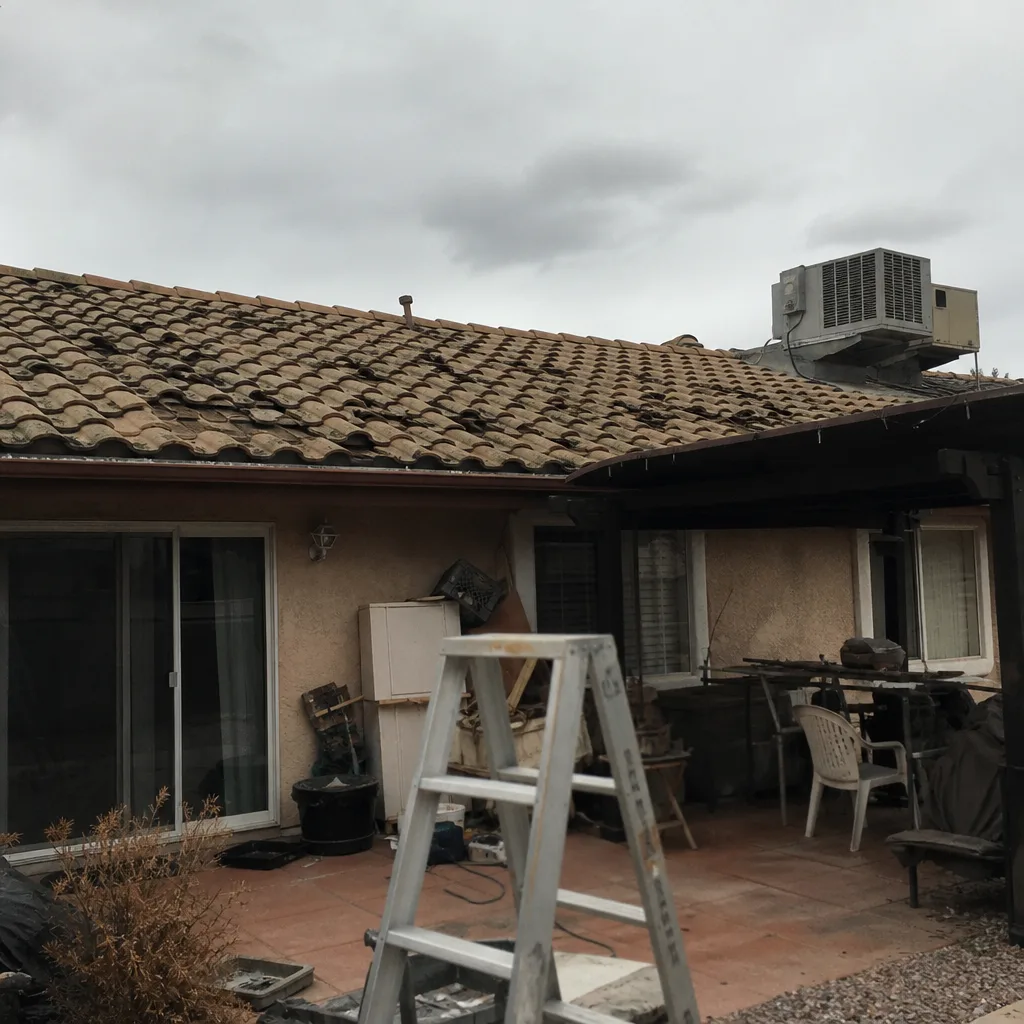
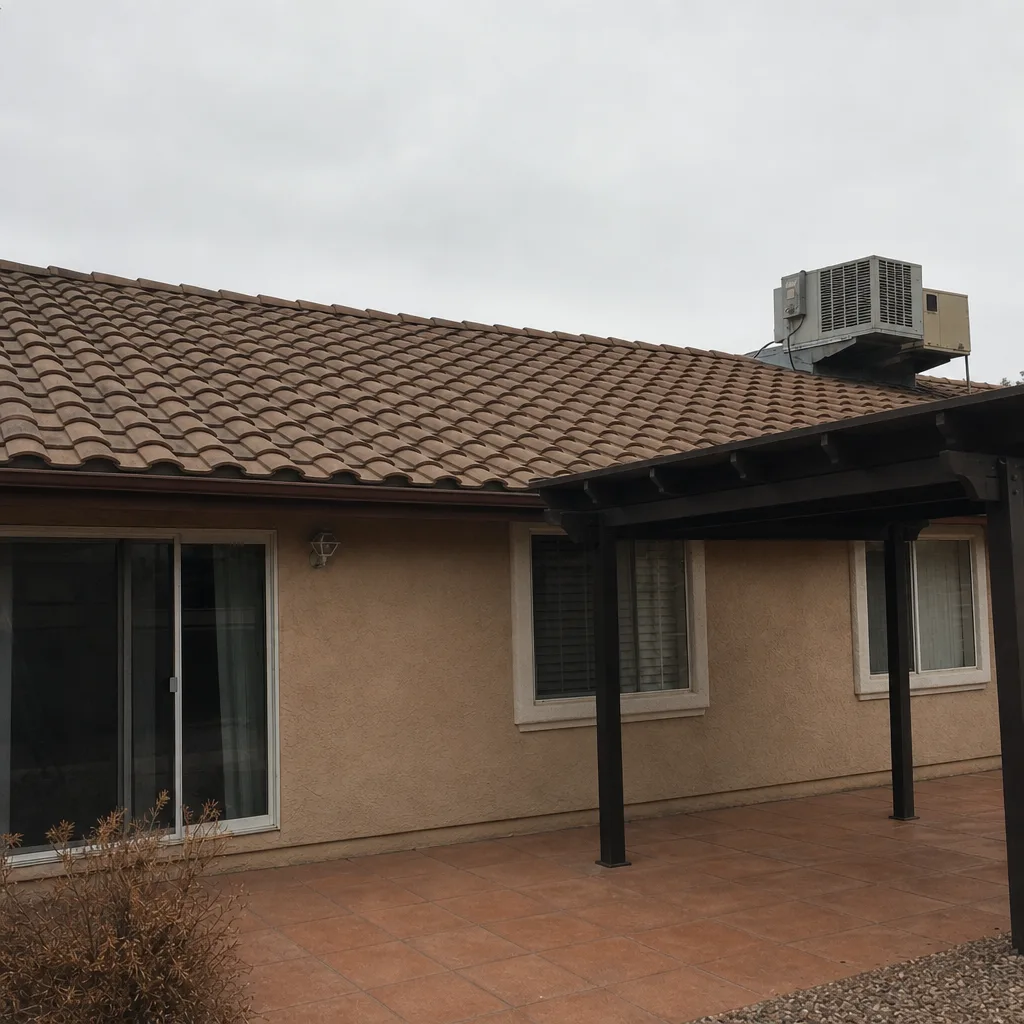
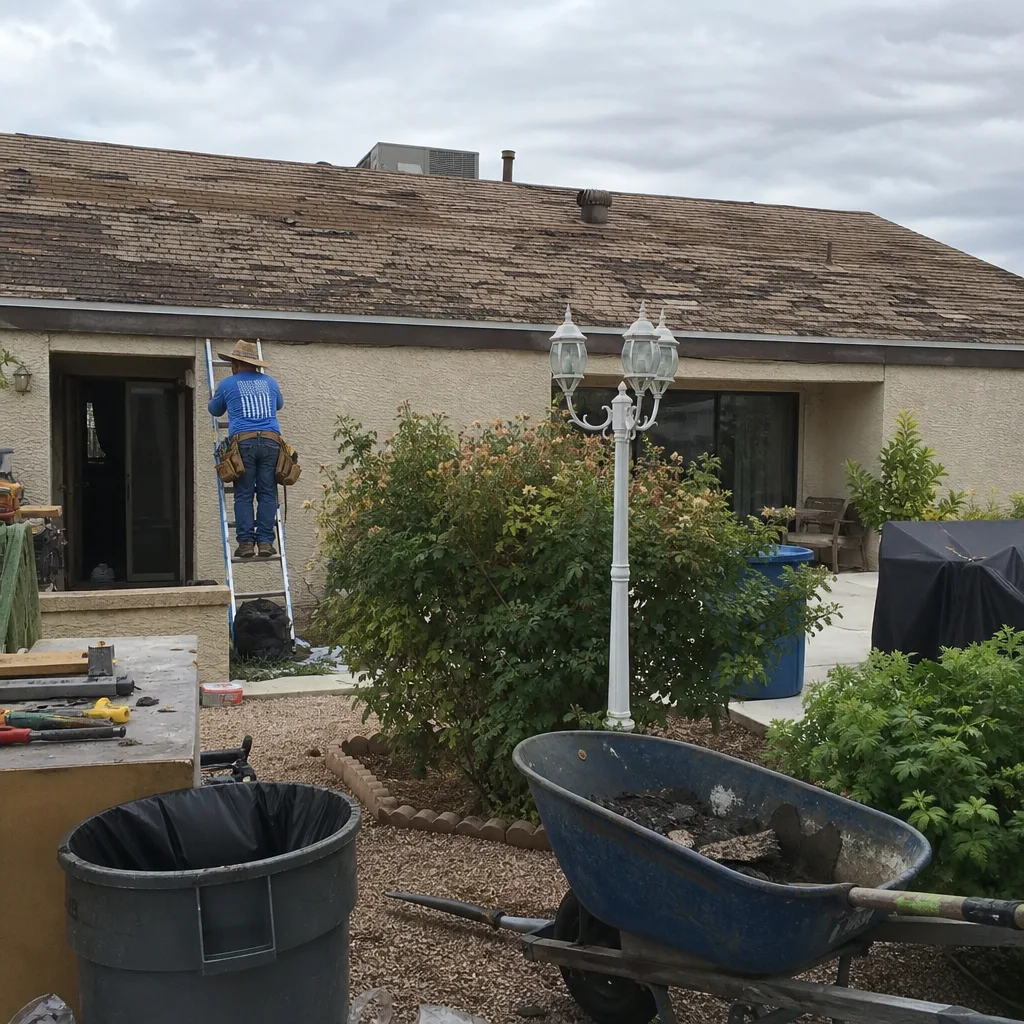
See the difference
 Before
 After
 Before
 After
 Before
 After
When to Call a Professional
Some tasks are yours to do from the ground; others aren’t. Call a professional if you see granule buildup accelerating, if a flashing joint looks lifted or you can’t safely reach it, if a tile roof has cracked field tiles near foot-traffic paths, or if any water stain appears on an interior ceiling. Skip the ladder and the roof edge entirely if you’re not comfortable with heights, and never attempt high-tension work or anything on a steep pitch yourself. Ridgeline Roofing Co. Henderson offers free estimates in Henderson, backed by the 90-Day Done Right Promise and upfront pricing where the number on the estimate is the number on the invoice. Call (833) 691-6717.
Frequently Asked Questions
Three times a year works for a Henderson roof: a pre-monsoon check in May or June, a post-monsoon inspection in October, and a light winter pass after the cool-down. The October inspection is the most important, because it catches thermal-shock damage before it grows. Call (833) 691-6717 for a free estimate if anything turns up.
October is the best window. The monsoon season has ended, the thermal cycling has settled, and repairs can be completed in a single visit before the cool-down. Booking in October also means you’re not competing with spring storm-season demand. Call (833) 691-6717 for an exact quote; estimates are free.
Failing flashing, dried caulk joints, and split pipe boot seals are the top three, especially right after the first monsoon rain following months of dry heat. Those components dry out and crack all summer, then leak the moment water arrives. The pre-monsoon checklist is built around them for that reason.
Track granule loss year over year. If the grit collecting under your downspout grows noticeably each monsoon season, and you see bare, smooth patches on the shingles, the roof is thinning. A professional inspection confirms whether it’s a repair or a full replacement.
It can. Most warranties from brands like Owens Corning, IKO, Atlas, and Tamko expect proper maintenance and no neglect. Keep a dated log and photos of every inspection and repair, and request a written report after professional visits. That documentation is what protects coverage if a claim ever comes up.
Yes, and it’s one of the most common causes of cracked field tiles on Henderson tile roofs. A single cracked tile lets water reach the underlayment. Check the path to your AC unit annually and have any cracked tiles replaced before monsoon season.
The Bottom Line
A Henderson roof rewards a calendar built around drought, heat, and the rain that follows, not a generic twice-a-year checklist copied from a wetter climate. Watch the granule trend at your downspout, run the pre-monsoon checklist on flashing, caulk, and pipe boots, and treat the October inspection as the anchor of the year. Keep a written log so your warranty stays intact. Most of this you can do from the ground; the rest belongs to a crew that climbs roofs for a living. Done right, a roof here lasts a long time, and keeping it that way is mostly about timing.
If you want the schedule handled by people who know this desert, call Ridgeline Roofing Co. Henderson at (833) 691-6717 for a free estimate. We document every inspection with photos from your actual roof, quote upfront pricing, and stand behind the work with the written 90-Day Done Right Promise. No paperwork, no arguing.
Written by the team at Ridgeline Roofing Co. Henderson.