
Last updated November 18, 2026
 Architectural shingles
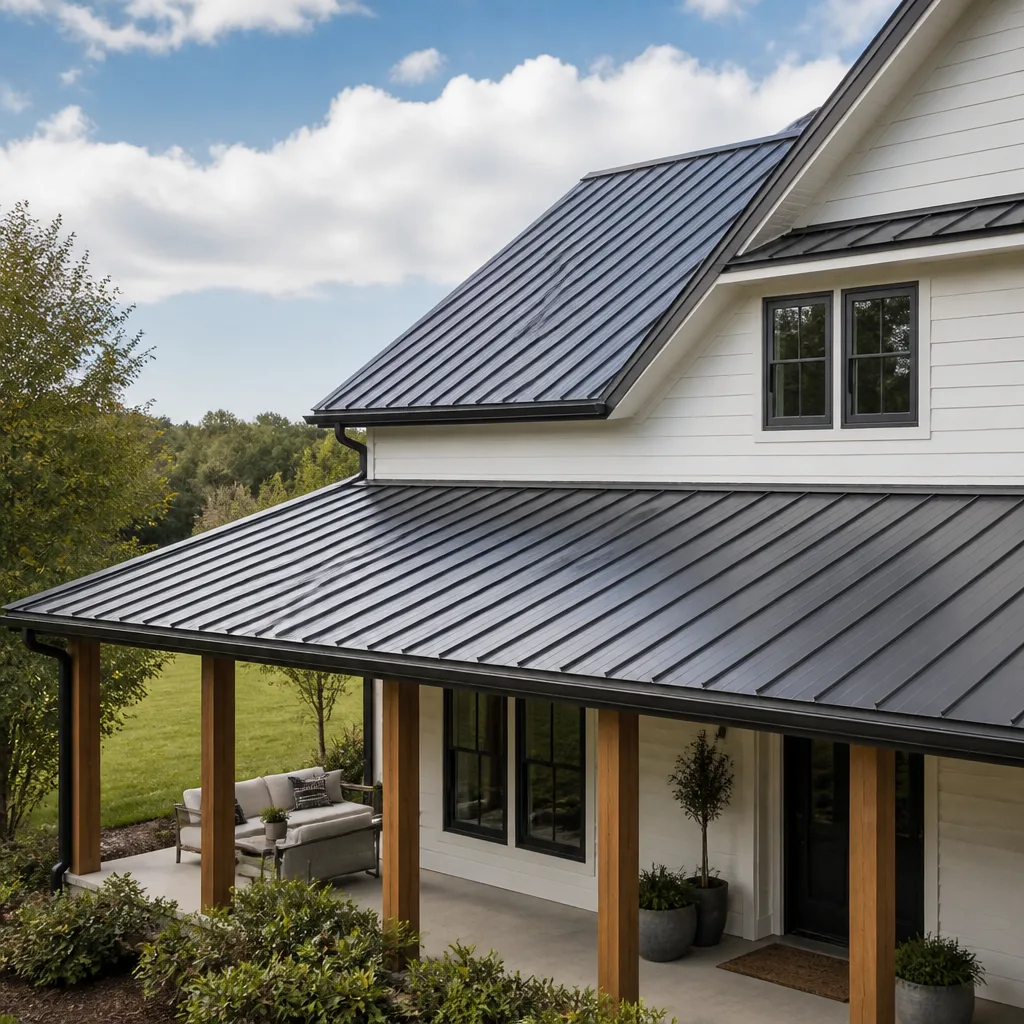 Metal roofing
 Tile roofing
 GAF
 Owens Corning
 Flat & low-slope
Free roof inspection with deck photos before we talk money - GAF and Owens Corning certified installation
The Complete Emergency & Storm Damage Guide for Henderson Homeowners
Henderson sits at the edge of the Mojave where monsoon moisture collides with superheated desert air, and the storms that result spin up in under 30 minutes. That short fuse is the whole problem. A cell that forms over the McCullough Range can be dropping hail on your street before a crew dispatched from anywhere else has pulled out of the lot. The homeowners who come through monsoon season with the smallest repair bills are the ones who made their decisions before the storm, not during it. This guide walks through the three kinds of weather that actually damage Henderson roofs, the first 24 hours after a hit, how to document for an insurance adjuster, and how to spot a storm chaser on the very first phone call.
Quick Answer
After storm damage in Henderson, the correct order is: make the roof safe from further water intrusion, photograph everything before anyone touches it, then call your insurer and a local roofer for a written inspection. Do not climb the roof yourself, do not let anyone start permanent repairs before the adjuster sees it, and do not sign anything from a contractor who knocked on your door the day after the storm. Most Henderson storm damage falls into three buckets – monsoon microbursts, haboobs, and rare winter hail – and each one damages a roof differently.
Styles & brands we work with
- Architectural shingles
- Metal roofing
- Tile roofing
- GAF
- Owens Corning
- Flat & low-slope
Table of Contents
- The Three Storms That Damage Henderson Roofs
- Monsoon Microbursts: Tile, Gutters, and the Ridge Line
- Haboobs: What Desert Dust Actually Does to a Roof
- Winter Hail: The Rare Event That Costs the Most
- The 24-Hour Post-Storm Checklist
- Tarping Done Right (and Why It Matters for Warranties)
- Documenting Damage Before Anyone Touches It
- How to Spot a Storm Chaser in Henderson
The Three Storms That Damage Henderson Roofs
Not every storm that crosses the valley hits a roof the same way, and knowing which one just passed over your house tells you what to go look for. In our experience across Henderson, damage almost always traces back to one of three weather patterns.
- Monsoon microbursts (July through September). A column of cooled air drops out of a thunderstorm and hits the ground like a bucket tipped over, spreading 60 to 80 mph winds in a straight line for a few hundred yards. These are the storms that peel clay and concrete tile off south and west-facing slopes, rip gutters off fascia boards, and pop ridge caps along the peak.
- Haboobs (dust storms, most common July through September). Walls of dust that can run 2,000 to 3,000 feet high and drive fine sand at 40 to 60 mph. Sand abrades the surface of low-slope membrane and granules on asphalt shingles, and it packs into HVAC penetrations, valley flashings, and the gaps around vent boots.
- Winter hail (rare, but expensive). Henderson gets a true hail event perhaps once every several winters, but when a cold core storm drops pea to marble-sized hail on a shingle roof, granule loss can shave years off the shingle’s life in a single afternoon. Tile and metal tend to fare better; asphalt takes the hit.
Understanding which storm just passed matters because it tells you where to look first: the windward slope after a microburst, the flat sections and penetrations after a haboob, the asphalt fields after hail. That’s the difference between finding damage and missing it until the next rain finds it for you.
Monsoon Microbursts: Tile, Gutters, and the Ridge Line
Microbursts are the signature summer storm in Henderson, and they leave a fingerprint. Because the wind comes in a straight line from one direction, damage tends to concentrate on the side of the roof facing the storm, plus the ridge line where the two slopes meet.
What we typically see after a microburst in neighborhoods like Green Valley and Anthem:
- Displaced or cracked tile. Concrete and clay tile can lift, shift, or crack under 70 mph gusts. A single displaced tile seems minor until the underlayment beneath it is exposed to UV and the next rain.
- Ridge cap failure. The mortar or fasteners holding ridge caps along the peak are the most wind-exposed part of any tile roof. Caps lift, slide, or pop off entirely.
- Gutter detachment. Gutters full of desert dust and debris become sails. When a microburst hits, the whole run can pull away from the fascia, sometimes taking fascia board with it.
- Flashing loosening around vents and skylights. Wind gets under the edges of step flashing and peels it back, opening a path for water.
If a microburst just came through, walk the outside perimeter of your house at ground level and look up at the ridge and the windward slope with binoculars. Missing caps and lifted tiles are usually visible from the driveway, and that quick look tells you whether a professional inspection is warranted. It almost always is after a storm of that size – our roof repair in Henderson crew sees the same pattern every July and August.
Haboobs: What Desert Dust Actually Does to a Roof
A haboob looks dramatic on the news, but the damage it does is quiet and cumulative. Fine sand driven at high speed doesn’t rip materials off a roof – it wears them down and clogs the parts that need to breathe.
Here’s what a haboob typically leaves behind on a Henderson roof:
- Abrasion on shingle granules. The mineral granules on asphalt shingles are the roof’s UV shield. Repeated sand blasting wears them thinner, and a thin-granule shingle ages faster and reflects more heat into the attic.
- Clogged HVAC penetrations and vent boots. Sand packs into the openings around pipe boots and HVAC curb penetrations. When those openings are full, the next rain can back up under the seal instead of draining away.
- Debris in valleys and against flashings. Dust and grit collect in the valley where two roof planes meet, and against step flashing. That debris holds moisture after a rain and traps it against the metal.
- Clogged gutters. A haboob can deposit a layer of dust and debris that turns a clear gutter into a dam in one afternoon.
After a haboob, a garden hose on the lower roof slope and a check of the gutters and penetrations is worth the twenty minutes. If you see grit packed into the valleys or around the HVAC, a professional inspection will find the penetrations that need re-flashing before the monsoon finishes its work. We’ve watched many Henderson haboob seasons, and the roofs that get an annual tune-up consistently skip the damage entirely.
Winter Hail: The Rare Event That Costs the Most
Winter hail is the storm Henderson homeowners forget to plan for, and it’s the one that racks up the biggest insurance claims. A cold core storm dropping even pea-sized hail can strip granules off an asphalt shingle roof in minutes, and granule loss doesn’t announce itself – the roof looks fine from the ground.
What hail actually does to Henderson roofing:
- Granule loss on asphalt shingles. Impact knocks granules loose, and the loss shortens the shingle’s service life. Worn spots show up as darker patches where the asphalt substrate is exposed.
- Bruising and mat damage. Even when shingles don’t crack, hail can bruise the fiberglass mat underneath, creating a weak spot that fails years later.
- Cracked tile and dented metal. Clay tile can crack on direct impact, and metal roofing can take cosmetic dents. On a metal roof, dents are usually cosmetic but worth documenting.
- Damaged soft metals. Hail dents gutters, downspouts, vent stacks, and ridge vents, and those dents are evidence an adjuster will want to see.
After a hail event, the right move is a professional inspection before you assume the roof came through fine. Shingle roofs over ten years old are the ones most vulnerable to granule loss. If the roof has reached the end of its service life anyway, a roof replacement and installation in Henderson may make more financial sense than a repair, and we’ll give you a straight answer either way.
The 24-Hour Post-Storm Checklist
The order of operations over the first day matters more than the speed. Here’s the sequence we recommend, and the one we follow on our own inspections after a Henderson storm.
- Check for active water intrusion inside the house. Walk the attic and the ceilings below the roof. Look for water stains, drips, and wet insulation. This is the first thing to establish because it tells you how urgent stabilization is.
- Look at the roof from the ground, not on top of it. Binoculars from the driveway are enough to spot missing caps, lifted tile, or obvious punctures. Do not climb a wet or wind-damaged roof, and do not let anyone else climb it without fall protection and a background-checked, uniformed crew.
- Photograph everything before you touch anything. The full exterior, the gutters, the ridge, the interior stains, and anything on the ground that fell off the roof. Timestamps and wide-angle shots do more for an adjuster than close-ups.
- Call your insurance company and open a claim. Ask them what documentation they want and when. Many policies require prompt notice, and a claim number on file protects you if further damage appears later.
- Stop water intrusion with a compliant temporary cover if needed. That means a proper tarp over the affected area, correctly fastened, not a plastic sheet flung over the ridge with a couple of bricks.
- Schedule a written, photo-documented inspection from a local roofer, ideally before any permanent repairs begin.
- Keep records. Receipts for tarps, rental equipment, and any temporary measures are part of the claim.
Tarping Done Right (and Why It Matters for Warranties)
A tarp thrown over a roof the wrong way can cause more harm than the storm did, and in some cases it can complicate a manufacturer warranty when permanent repairs are installed over a compromised deck. Here’s what a compliant emergency cover actually looks like, and where the corners get cut.
- The tarp is anchored above the damage, not at the ridge only. Water has to be able to run off and away. Tacking a tarp only at the top edge lets the wind get under it and lets water pool against the damaged material.
- The fasteners are on the non-weather side. Screws or battens through a tarp should be placed where they don’t create new penetrations through the roof surface. A towel, a rock, or a brick is not an anchor.
- The tarp does not cover venting or gutters. Blocked ventilation traps heat and moisture under the deck, and blocked gutters send water behind the fascia.
- The tarp is temporary, measured in days, not months. UV degrades a plastic tarp fast in Henderson sun, and a tarp left up long enough can trap moisture against the deck and create stains that confuse the adjuster later.
We get asked about this constantly, because a bad tarp job is one of the most common ways Henderson homeowners accidentally weaken a claim or add work later. The safest answer is to let a professional do the cover, and to schedule a written inspection at the same time. That’s exactly the kind of repair work our Henderson roof repair team handles, and we document the cover in photos so the adjuster sees what was done and why.
Documenting Damage Before Anyone Touches It
An insurance adjuster can only pay for damage they can see and verify. If you cleaned up too fast, you’ve thrown away evidence. Here’s the smartphone documentation routine that holds up.
- Take wide shots first. Every side of the house, from ground level, with the whole roof in frame. Timestamp and location are automatic on most phones.
- Get close-ups of the specific damage. Missing tile, lifted ridge cap, torn gutter, granule wear, dents in the gutters and vent stacks.
- Photograph the interior stains. Ceiling, walls, and any water marks in the attic. Set a coin or a ruler next to a stain for scale.
- Photograph anything that came off the roof. Fallen shingles, tile pieces, and gutter fragments belong on the ground where they landed, not swept up.
- Keep a written log. The date and time of the storm, when you noticed damage, who you called, and when. This log answers the adjuster’s questions without you having to remember.
- Do not dispose of any damaged material until the adjuster has seen it. That includes shingles, tile, and gutter sections.
One photo rule that pays off: take the same wide shot at the end of every month after the storm passes. If damage progresses, that timeline shows it.
How to Spot a Storm Chaser in Henderson
Storm chasers follow weather, not neighborhoods. They show up the day after a big event, knock on doors along the worst-hit streets, and disappear before the second rain. Here’s what that looks like in Henderson, and the three questions that separate them from an established local roofer on the very first phone call.
- They knocked on your door unsolicited. A local roofer you didn’t call doesn’t knock. They also tend to arrive in unmarked vehicles and without uniforms.
- They want to sign a contract the same day. Pressure to sign on the spot is the biggest warning sign, especially if they offer to “handle the insurance for you.”
- Their references are all out of state. Ask for three Henderson or nearby addresses they’ve worked on that you can verify.
- Their price is dramatically lower than everyone else’s. A bid that undercuts every other by thousands usually means shortcuts hidden in the fine print.
The three questions to ask on the first call:
- “What is your written workmanship guarantee, and how long is it?” A local contractor will name a specific written guarantee without hesitation. A storm chaser will talk about a manufacturer warranty and avoid the question.
- “Are your technicians background-checked and uniformed, and will the same crew install and warranty the job?” Established local roofers can answer this in a sentence.
- “Are you licensed, insured and bonded, and can you give me a written estimate with no change orders?” A legitimate contractor gives you written line-item pricing. A storm chaser gives you a verbal number that grows once the tarp comes off.
Comparing roofing bids side by side is where most Henderson homeowners get stuck, and it’s also the step where the best contractors reveal themselves. Our Ridgeline Roofing Co. Henderson home page lays out what we do differently, and our specialty roofing in Henderson work covers the tile, metal, and flat systems that take the hardest hits in storm season.
Common Mistakes to Avoid
- Climbing the roof to inspect it yourself. Wet tile and wind-damaged shingles are some of the most dangerous surfaces you can step onto, and one slip is a hospital visit. Let a trained, insured professional do the inspection.
- Calling a storm chaser because they showed up first. Speed of arrival isn’t a qualification, and the first truck on the street after a Henderson storm is often the one least likely to be in town next spring.
- Cleaning up before you photograph. Swept-up shingles and hauled-off tile remove the only physical evidence your adjuster can see. Photograph first, dispose later.
- Signing a contract before you’ve seen a written estimate. A verbal number turns into a change order, and the written estimate is the only one that holds.
- Skipping the interior check after a storm. Water damage starts in the attic and the ceiling before it reaches a living room. A quick scan of the attic after every storm catches it early.
- Letting a friend tarp the roof with a plastic sheet and bricks. A non-compliant cover can trap moisture against the deck and complicate your warranty and your claim.
- Assuming tile is fine because it looks fine. Displaced tile and underlayment exposed to UV can fail for months before a rain finds it. A written inspection after every major storm is the only reliable check.
See the difference
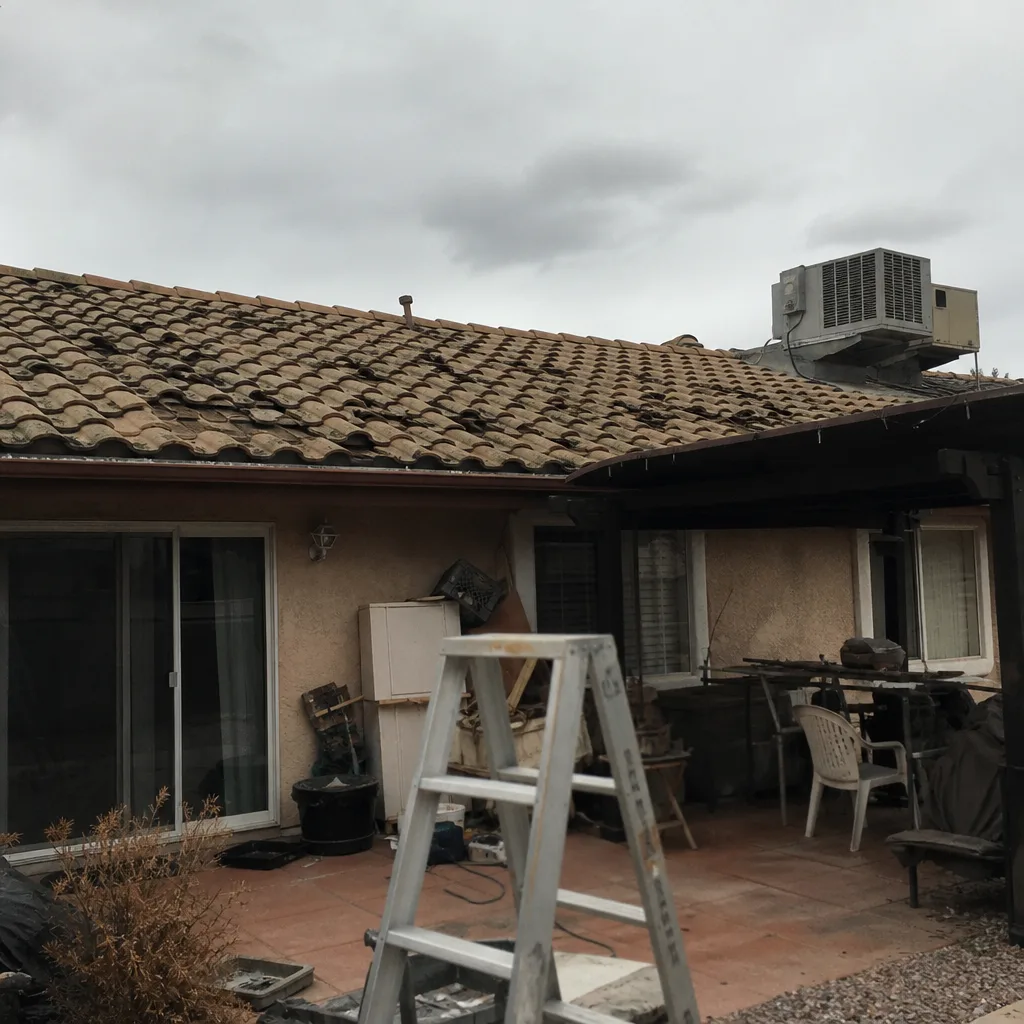 Before
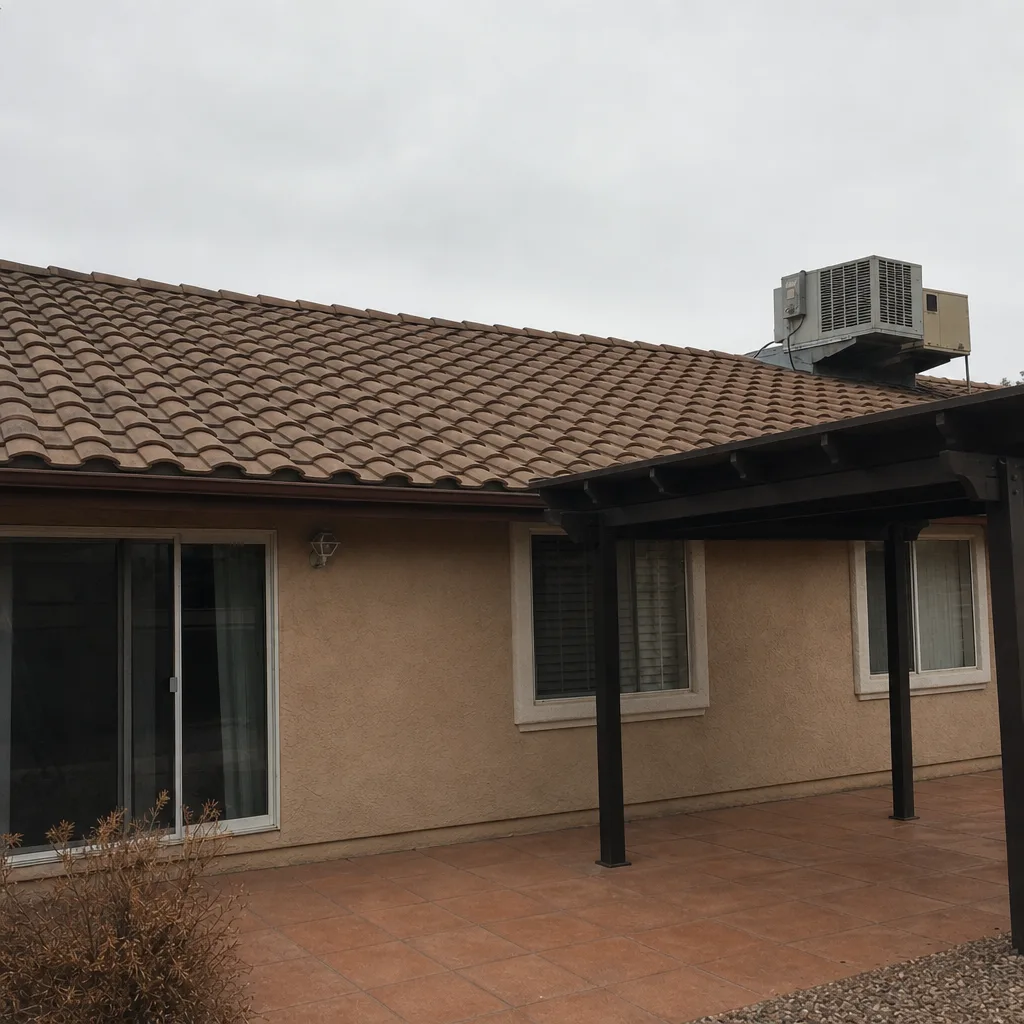 After
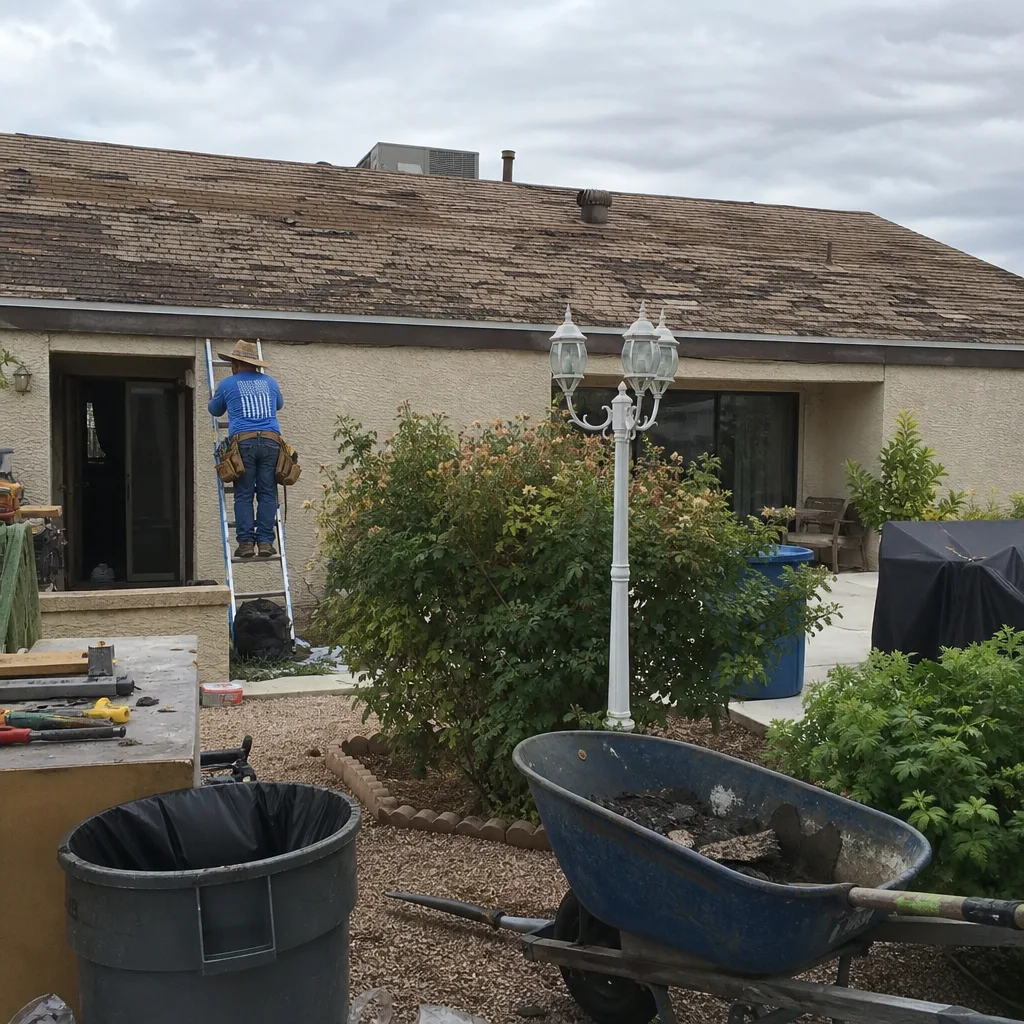 Before
 After
 Before
 After
When to Call a Professional
Call a professional roofer after any storm that produced 60 mph winds or more, any measurable hail, or any haboob that deposited visible grit on your roof and in the gutters. Also call if you see water stains on a ceiling, granules piling up in the gutters, missing ridge caps from the ground, or a section of gutter separated from the fascia. And call if the roof is over ten years old and you can’t recall a written inspection in recent memory – storm damage tends to show up first on the roofs least recently looked at. Ridgeline Roofing Co. Henderson offers free estimates in Henderson, with a written, photo-documented inspection from a background-checked, uniformed crew. Call (833) 691-6717 to schedule one.
Frequently Asked Questions
Make the roof safe from further water intrusion, then photograph every sign of damage before anything is touched. Don’t climb the roof yourself. Call your insurer to open a claim, and schedule a written, photo-documented inspection from a local roofer. Call (833) 691-6717 for an exact quote – estimates are free.
Most storm-related repairs in Henderson land between a few hundred dollars for replacing displaced tile or re-securing a ridge cap and several thousand for a section repair that involves underlayment or decking. Full replacements are far more expensive, which is why a written inspection before you commit to a repair matters. Call (833) 691-6717 for an exact quote – estimates are free.
Most homeowners policies in Nevada cover sudden storm damage, including wind, hail, and the water intrusion that follows, though the exact coverage depends on your policy and deductible. Document the damage before cleaning up, open the claim promptly, and get a written inspection with photos to submit with it. Call (833) 691-6717 to schedule the inspection that supports the claim.
Granule loss from hail often shows up as darker patches and piles of granules in the gutters rather than visible holes. A roof that looks fine from the ground can have bruised shingle mats that fail years later, so a professional inspection is the only reliable check. Call (833) 691-6717 for a free estimate on an inspection.
A tarp installed the wrong way can trap moisture against the deck, block venting, and complicate both your manufacturer warranty and your insurance claim. A compliant cover is anchored above the damage, keeps gutters and vents clear, and stays up only until permanent repairs start. Call (833) 691-6717 to schedule a written inspection and proper emergency cover.
Ask three questions on the first phone call: what’s your written workmanship guarantee, are your technicians background-checked and uniformed, and are you licensed, insured and bonded with a written no-change-order estimate. A storm chaser will dodge at least one of them. Call (833) 691-6717 to speak with a live person right now – a real one answers.
The Bottom Line
Henderson storm damage is predictable once you know the three patterns – monsoon microbursts that peel tile and gutters, haboobs that abrade shingles and clog penetrations, and rare winter hail that strips granules and bruises mats. The homeowners who come out cleanest are the ones who act in the right order: secure the roof, photograph everything, open the claim, then get a written inspection from a local roofer before anyone touches a shingle. That order protects both the structure and the claim, and it’s the difference between a repair and a replacement. Ridgeline Roofing Co. installs GAF, CertainTeed, Owens Corning, IKO, and Tamko systems, backs every job with a written 90-Day Done Right Promise, and answers the phone live at any hour. Call (833) 691-6717 for a free estimate. The price we quote is the price you pay, and if it’s not right, we make it right.
Written by the team at Ridgeline Roofing Co. Henderson.