
Last updated November 18, 2026
 Architectural shingles
 Metal roofing
 Tile roofing
 GAF
 Owens Corning
 Flat & low-slope
Free roof inspection with deck photos before we talk money - GAF and Owens Corning certified installation
Gutters & Accessories Warning Signs Every Homeowner Should Know
The gutter itself rarely looks bad right up until it fails. What fails first is everything around it. We’ve stood on roofs across Henderson and found gutters that looked perfectly sound from the ground while the fascia board behind them had been quietly rotting for two rainy seasons. The real story shows up in secondary places: the rust stain on the stucco three feet below a seam, the soft spot at the base of the fascia behind a bracket, the soil erosion channel cutting through a landscape bed. This guide walks you through the five places where failing gutters leave their fingerprints first, what each pattern tells you about the type of failure, and why catching these clues in Henderson’s climate matters more than most homeowners realize.
Quick Answer
Most gutter failures give you a 90-day warning window, and the signs almost never appear on the gutter itself. Check the fascia board behind the hangers, the soffit underside, the foundation soil line, the stucco or siding staining patterns, and the landscape erosion lines. Any one of those showing moisture damage means the gutter system is already failing, even if the gutter looks fine from the ground.
Styles & brands we work with
- Architectural shingles
- Metal roofing
- Tile roofing
- GAF
- Owens Corning
- Flat & low-slope
Table of Contents
- Why Gutters Fail From the Edges In, Not the Middle Out
- The Five Places to Inspect Before You Look at the Gutter
- What a Paint Stripe vs. a Rust Streak Tells You About the Failure
- The Henderson Monsoon Clue: Sediment That Never Drains
- Sagging Gutters: Fastener Problem or Fascia Rot?
- The Interior Warning Sign Homeowners Almost Always Misread
- A Step-by-Step Inspection You Can Do From the Ground
- Gutter Accessories That Prevent the Five Failures
Why Gutters Fail From the Edges In, Not the Middle Out
A gutter is a drainage system, and drainage systems fail at their connections, not their middles. The stretch of gutter running across the front of the house will hold water for years. The hanger at the corner, the seam where two runs meet, the outlet where the downspout takes the water away: those are where the pressure concentrates. When they start to go, water escapes a few ounces at a time, runs down the outside of the fascia, and soaks into the wood behind the gutter where no one can see it.
We’ve seen this pattern enough on Henderson homes to know the timeline. A bracket loosens a fraction of an inch from thermal movement in July. By September, that gap holds a thin film of water against the fascia board after every rain. By the following spring, the wood under the bracket has softened enough that the fastener loses its grip entirely. The gutter sags, the homeowner calls, and by then the repair is not a fastener anymore. It’s a fascia board replacement plus re-guttering.
That’s the 90-day warning window. The gutter was “fine” the whole time. The house was not. Catching the failure earlier means catching it in the secondary locations, which is exactly what the rest of this guide covers. It’s the same discipline we bring to every roof repair in Henderson: find the cause before you fix the symptom, because the symptom is never the whole story.
The Five Places to Inspect Before You Look at the Gutter
Walk the perimeter of your house and look at these five locations. Each one reveals a different type of gutter failure, and each one is visible from the ground without a ladder.
- Fascia board behind the hangers. Look at the wood strip the gutter is attached to, right where the brackets meet the board. Dark staining, soft wood, or bubbling paint at those attach points means water has been sitting against the fascia. That’s a fastener-level failure in progress.
- Soffit underside. Stand under the eaves and look up. Water stains, peeling paint, or a chalky white residue on the soffit means water is backing up under the roof edge, usually because the gutter is overflowing or the downspout is blocked.
- Foundation soil line. Look at the dirt where the house meets the ground, especially at the corners and under downspout outlets. A trench, a dark damp patch that stays wet days after rain, or soil washed away from the slab means water is dumping next to the foundation instead of running away from it.
- Stucco and siding staining. Stucco is the standard exterior across most of Henderson, and it shows water patterns clearly. A vertical stripe running down the wall below a gutter seam tells you exactly where the leak is. Rust-colored streaks tell you something different from paint-colored ones, and the next section breaks that down.
- Landscape erosion lines. Look at the gravel, rock beds, and plant borders under the eaves. A channel carved through the rock, a depression in the soil, or dead plants in a straight line all trace the path water takes when it misses the gutter entirely.
Any one of these showing damage is a reason to get the system looked at. Two or more together means the gutter has been failing for a while.
What a Paint Stripe vs. a Rust Streak Tells You About the Failure
The color of the streak running down the wall below the gutter is diagnostic. It tells you which kind of failure you’re looking at, and that changes what the repair involves.
- A paint-colored or chalky stripe usually means overflow. Water is spilling over the front lip of the gutter because the gutter is full of debris, the downspout is blocked, or the gutter was undersized for the roof area. The water runs down the wall face and strips the paint or stucco finish as it goes. The fix is often cleaning, re-sloping, or resizing the downspout, not replacing the gutter.
- A rust-colored or brown streak usually means a joint leak or a pinhole failure. The water is escaping through a seam or a rusted-through spot in the metal itself, and it carries the corrosion color with it as it runs down the wall. Rust streaks that start exactly at a seam are almost always a joint failure. On older steel gutters, pinholes in the gutter floor produce the same rust staining on the fascia below.
- A dark, muddy streak with grit in it usually means a hanger pull. The gutter has separated from the fascia at one or more brackets and is hanging low enough that water and roof grit are escaping behind the gutter face instead of through it. This is the failure that costs the most when ignored, because the fascia board behind the hanger is soaking the whole time.
- A clean water mark with no color that fades as it dries is often simple condensation or splash from a hard rain hitting the wall. Not every streak is a failure, and we’d rather tell you that than sell you a gutter replacement you don’t need.
Read the streak first, then look at the gutter. The streak tells you where to look.
The Henderson Monsoon Clue: Sediment That Never Drains
Henderson has a specific gutter failure pattern that comes straight from the desert climate. Winds blow fine dust and grit onto roofs all summer, and when the monsoon storms arrive in July and August, that sediment washes into the gutters along with the rain. A well-sloped gutter moves that sediment to the downspout and clears it. A gutter with a slope problem does not. The sediment settles, the water sits, and the gutter stays damp for weeks after the last storm passes.
If you’ve had the gutters cleaned and they still hold standing water days after a rain, the problem is not a cleaning problem. It’s a slope correction problem. The gutter needs to be re-hung at the correct pitch, usually a quarter inch of drop per ten feet of run toward the outlet. That’s not something a garden hose and a ladder fixes. It requires re-setting the hangers and often replacing the ones that have pulled.
We see this most often on Henderson homes in the older neighborhoods where original gutters have been through twenty or more monsoon seasons. The hangers have shifted from repeated summer heat cycles, the slope has drifted, and no amount of cleaning gets the water out. The sign to watch for is simple: sediment that stays wet and never fully drains. That’s your cue to have the slope checked, not the drain snaked. If the roof edge above the gutter is also showing wear, it’s worth pairing the gutter inspection with a look at the roof replacement and installation in Henderson options at the same time.
Sagging Gutters: Fastener Problem or Fascia Rot?
A sagging gutter section is the most common thing we get called about, and it’s also the most commonly misdiagnosed. There are two causes, and they need completely different repairs. Here’s how to tell them apart before anyone shows up with a ladder.
- Push up gently on the sagging section from the ground. If it moves back into place against the fascia and stays there, even for a moment, the fastener has lost its grip but the fascia board is still structurally sound. That’s a fastener problem, and it’s the cheaper of the two repairs.
- Look at the wood behind the hanger. Soft wood, visible rot, wood that crumbles or flakes when touched, or a hanger sitting loose in a hole that’s clearly enlarged: that’s a fascia rot problem. The gutter cannot be re-hung onto rotted wood. The fascia board has to come off and be replaced first, then the gutter goes back on with new fasteners.
- Check whether the sag is at a hanger or between two of them. Sag at a hanger means the bracket failed. Sag between hangers, where the gutter dips in the middle of a span, means the hangers were spaced too far apart for the span or the gutter metal has deformed. Spacing needs to be corrected, usually from 24 inches down to 12 to 16 inches through the sagging section.
- Look for rust or corrosion at the fastener points. If the old fasteners show corrosion, the new ones will too unless the attachment method changes. On some installations, a hidden hanger screwed into the fascia is right; on others, an under-the-shingle hanger or a strap solves a persistent fastener problem.
We’ve seen homeowners pay for a gutter re-hang three times on the same section because nobody addressed the rotting fascia underneath. Fix the board first. Then the gutter holds.
The Interior Warning Sign Homeowners Almost Always Misread
Here’s the one that surprises people. A water stain at the top of a first-floor interior wall, right below the ceiling line, is usually blamed on a roof leak. Most of the time it’s not the roof. It’s the gutter.
The logic is straightforward once you see it. When a gutter overflows at the roof edge, water backs up under the first row of shingles or behind the drip edge. From there it wicks along the roof deck, finds the top plate of the wall below, and travels inside the wall cavity down to the ceiling of the floor underneath. The leak shows up at the top of the wall below the roof edge, not at the ceiling above it, because the water entered at the edge, not through the roof field.
That’s why an interior stain at the top of a first-floor wall is often a gutter overflow problem, not a roof failure. It’s also why a roofing contractor who only looks at the roof misses it. We inspect the gutter, the roof edge, and the wall transition as one system, because the water doesn’t respect those boundaries. The same logic applies to water stains on the outside of the second-story wall directly below the gutter line: that’s not the second-floor roof leaking, it’s the gutter above it failing.
Before you call a roofer about an interior stain, walk outside and look at the gutter above that wall. If it’s full, blocked, or sitting low at the edge, that’s the cause. If the interior stain is paired with attic moisture or missing shingles above the ceiling line, then it may actually be a roof issue and worth a second look at the roof repair side. But most of the time, the gutter is the answer.
A Step-by-Step Inspection You Can Do From the Ground
Here’s the inspection routine we suggest to homeowners who want to know whether it’s time to call. It takes twenty minutes and never requires a ladder. Anything that involves getting on the roof, especially above a two-story drop or onto a wet roof after a storm, is a job for a trained technician. Roofs are dangerous, and a fall in Henderson is not a small thing.
- Walk the perimeter once, looking only at the walls and fascia. Don’t look at the gutter yet. Note any staining, streaking, or soft wood. This is the diagnostic pass.
- Check every downspout outlet for evidence of water flow. Drop a garden hose into each downspout and let it run for a minute. If water backs up at the top or doesn’t run out the bottom, that downspout is blocked or disconnected.
- Look at the ground under each downspout outlet. A splash pan or rock bed is normal. A trench or channel cut into the soil or rock bed means the downspout is dumping directly at the foundation.
- Check the slope by running water into the gutter itself. Hose water into the high end of a gutter run and watch where it goes. It should move steadily to the outlet with no standing water.
- Look for sediment patterns at the bottom of the gutter. Even from the ground, sediment visible at the gutter seam or at a low spot between hangers tells you where the slope is wrong.
- Check the drip edge above the gutter. A quick look along the roof edge will show whether shingles overhang the drip edge correctly. Undersized overhang is a common cause of water running behind the gutter instead of into it.
Note anything on the list. If you find more than one problem on the walk, that’s when a proper inspection is worth the call. Our team documents every inspection with photos taken from the actual roof, so you see exactly what we see. It’s the same approach we bring to specialty roofing in Henderson for homeowners who want the details explained, not just the verdict.
Gutter Accessories That Prevent the Five Failures
Most of the failures in this guide are preventable with the right accessories, installed correctly. These are the ones we install most often on Henderson homes, and what each one solves.
- Hidden hangers instead of spike and ferrule. The old spike through the front of the gutter into the fascia loosens with every thermal cycle and leaves an open hole for water. Hidden hangers screw into the fascia and hide behind the gutter face, which is why they last longer in Henderson’s heat.
- Seamless gutter runs. A seamless gutter run removes the seams where joint leaks start. Most modern installations are seamless, so if you have visible seams every ten feet, that installation is old enough to inspect closely.
- Stainless steel micro-mesh gutter guards. These keep the summer dust and grit from settling into the gutter while still letting the monsoon rain through. On Henderson homes surrounded by desert landscaping or near open ground, this is the accessory that makes the biggest difference in the amount of sediment that reaches the gutter.
- Downspout extensions and splash pans. A short extension moves water three to six feet away from the foundation instead of dropping it at the slab. This is the cheapest accessory and the one that prevents the foundation soil damage that shows up on every inspection.
- Proper hanger spacing. Standard spacing for Henderson installations is 24 inches in the field with tighter spacing at corners and outlets. Spacing that’s too wide shows up as sag between hangers within a couple of seasons.
We install accessories from the same manufacturer lines we use for roofing, including GAF and CertainTeed, and we spec Tamko and Boral gutter systems where they’re the right match for the home. No substitutions without a conversation first.
Common Mistakes to Avoid
- Cleaning the gutters and calling it done. Cleaning moves the symptom out of the way but doesn’t fix the slope problem that let the sediment settle in the first place. If standing water remains after a cleaning, the slope needs correction.
- Re-hanging a gutter onto soft fascia. A new fastener in rotted wood pulls out within one season. The board has to come off and be replaced first, then the gutter goes back on.
- Mistaking a rust streak for paint fade. The color of the streak below a gutter tells you the type of failure. A rust streak means the metal itself is leaking, not that the paint has faded. Treat it as a joint failure until proven otherwise.
- Blaming the roof for an interior stain at the top of a first-floor wall. Most of the time the water entered at the roof edge, not through the roof field, and the gutter is the cause. Check the gutter before you call for a roof repair.
- Ignoring the splash bed under a downspout. A small trench in the rock bed looks harmless until it’s been carrying water at the foundation for three years. Foundation repair costs far more than a downspout extension.
- Letting anyone inspect the roof without photos. If a contractor can’t show you photos taken from your actual roof, you’re being told a story, not given an inspection. Always ask for the documentation.
- Taking the lowest bid without a fixed price in writing. A verbal estimate on a gutter job becomes a change order the moment the fascia rot is discovered. Get the number in writing with the scope attached, and confirm the price on the estimate is the price on the invoice.
See the difference
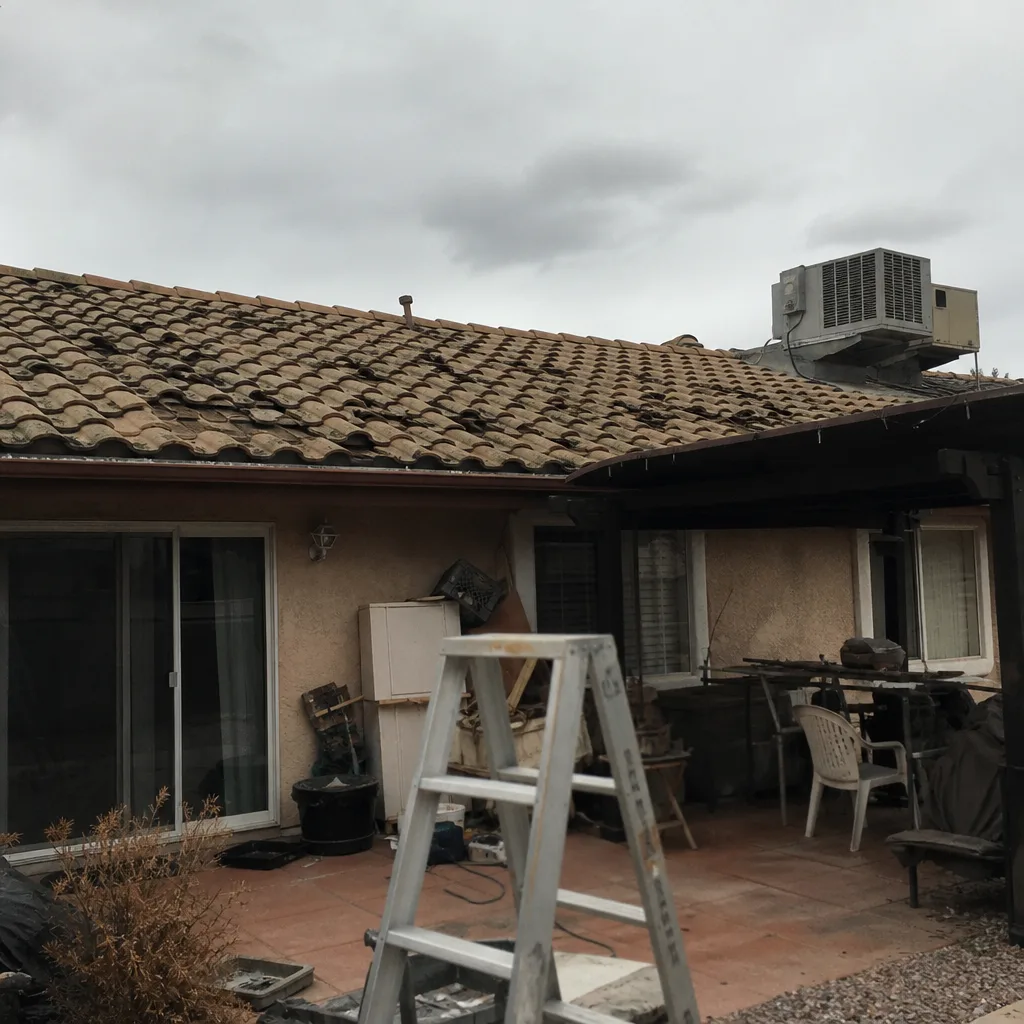 Before
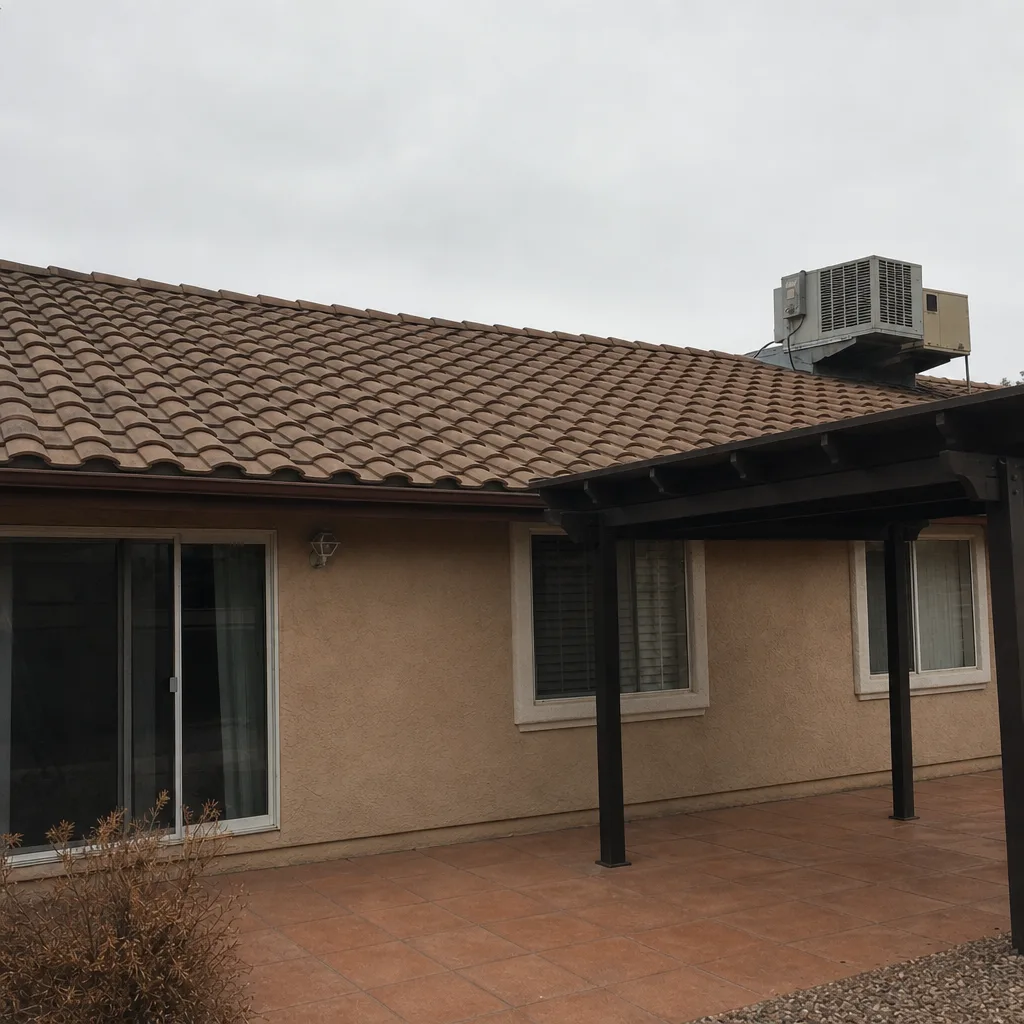 After
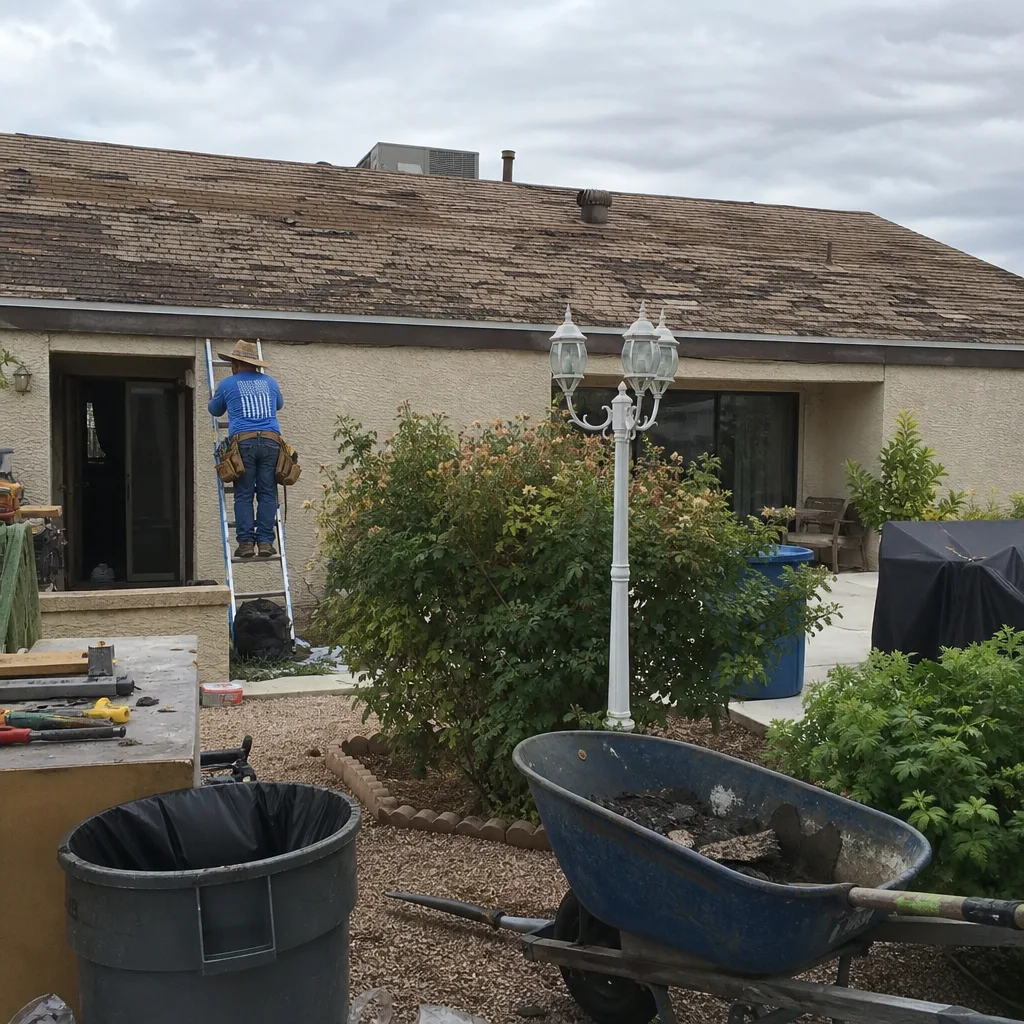 Before
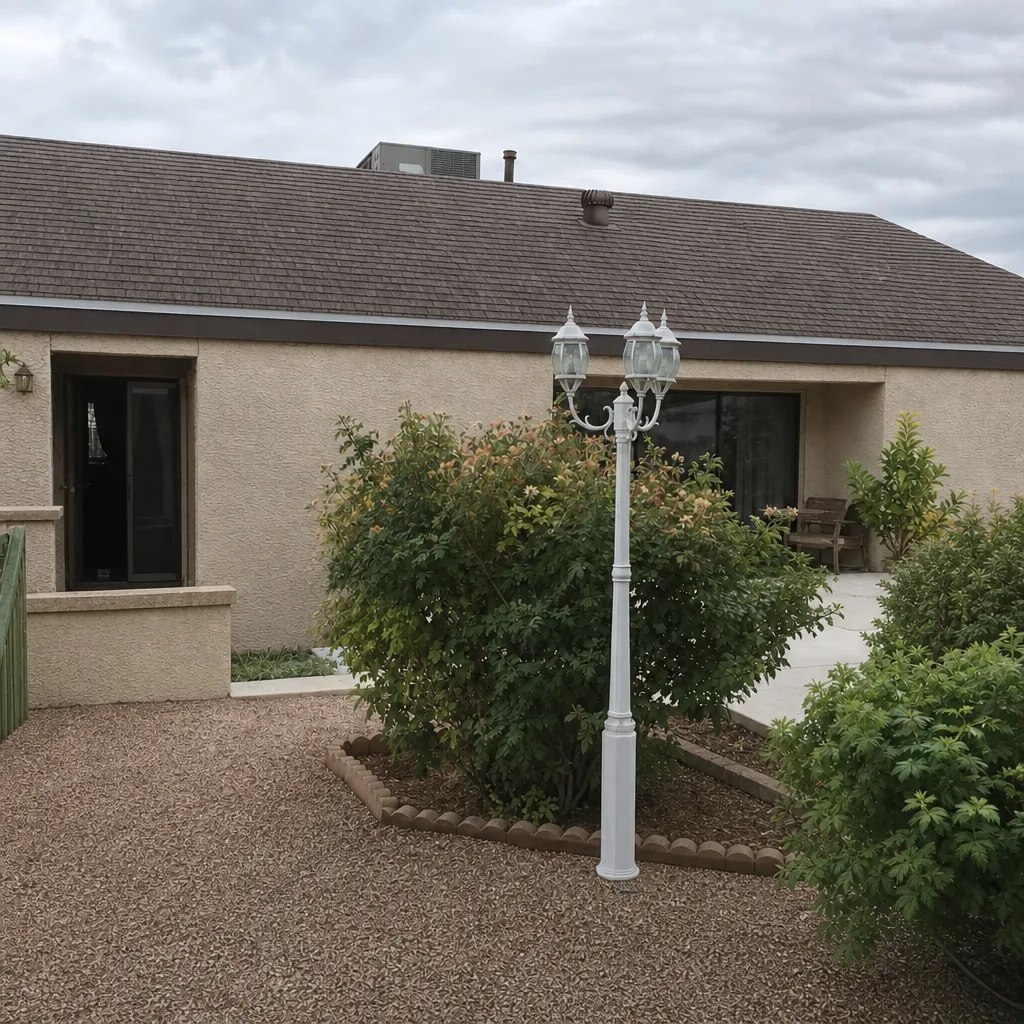 After
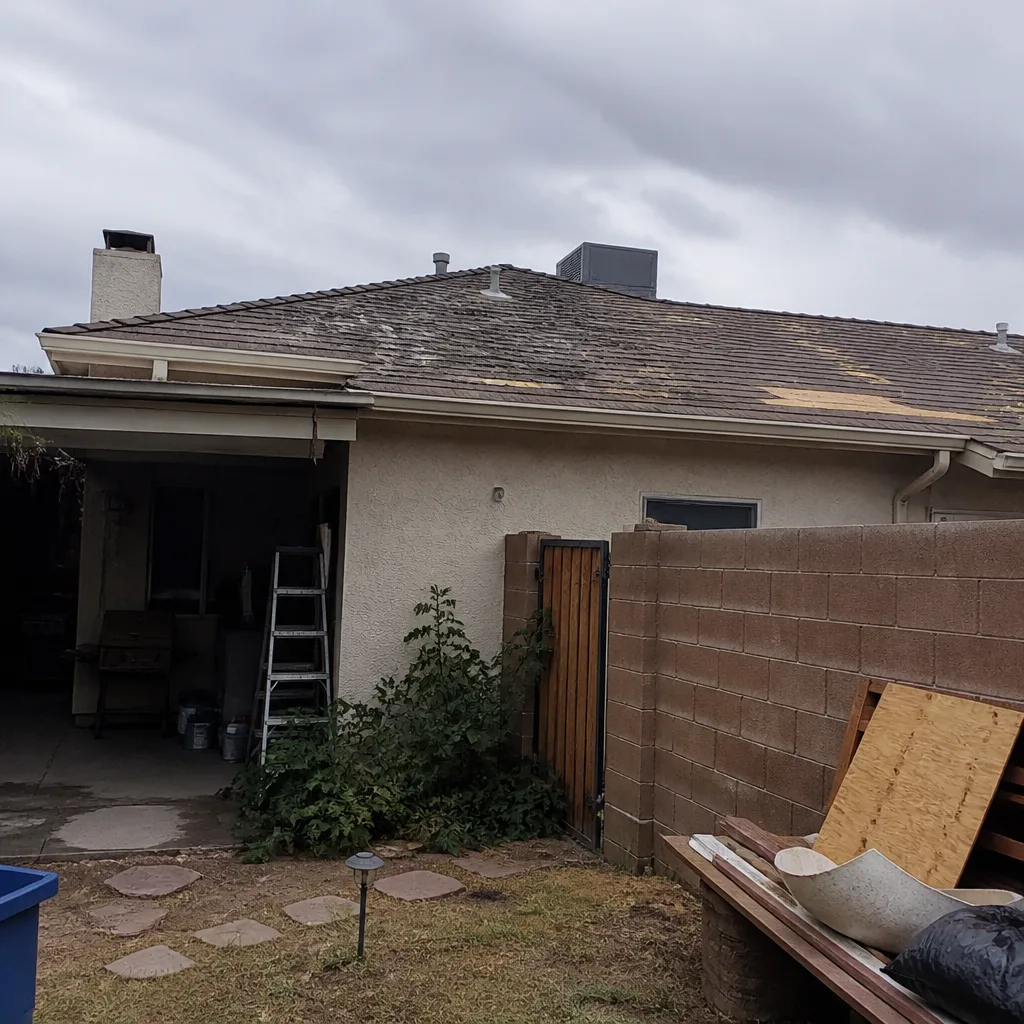 Before
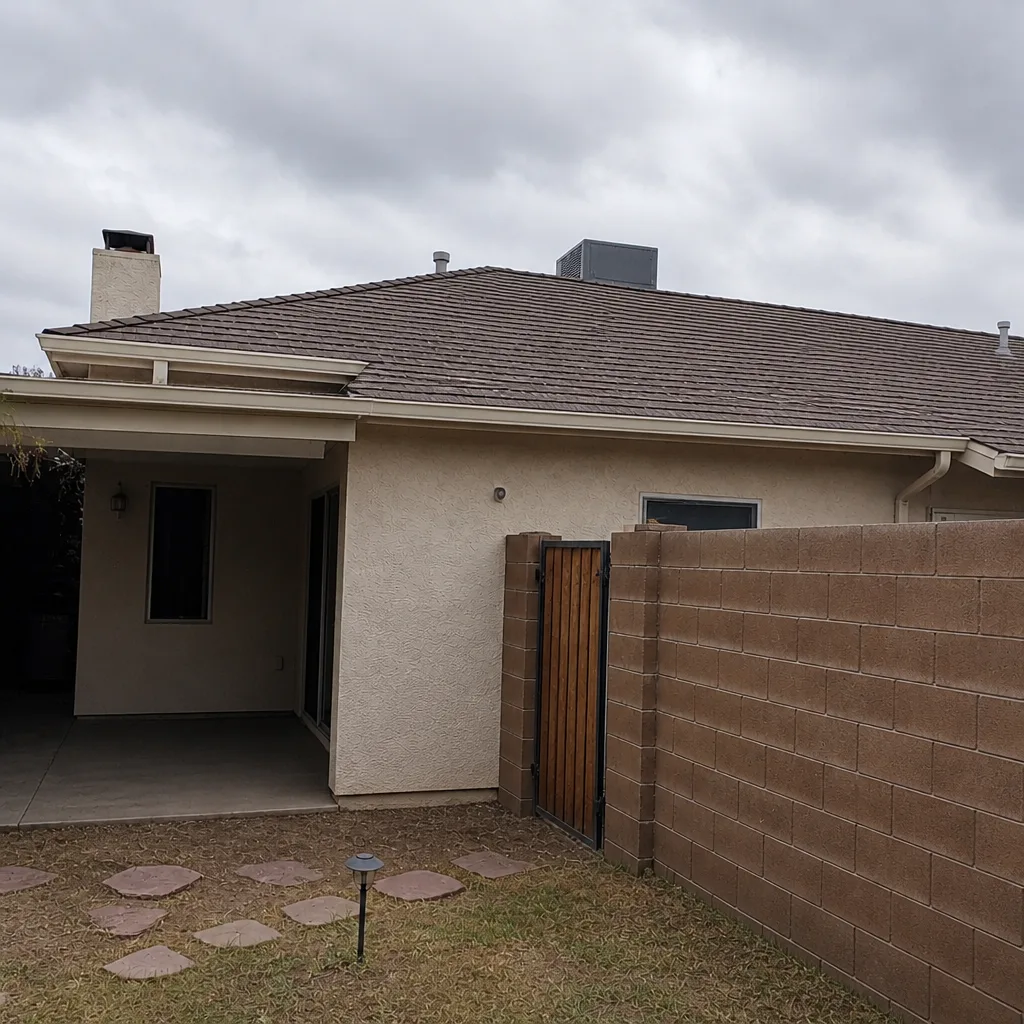 After
When to Call a Professional
Call a professional the moment you find more than one of the five secondary signs, or any single sign that has been present for more than a season. Water staining on the stucco, soft wood behind a hanger, foundation erosion at a downspout outlet, an interior stain at the top of a first-floor wall: any of those means the failure is already active and the cheap fix window has closed. Also call if you’re uncomfortable on a ladder or if the inspection requires getting on the roof. Gutters above a two-story drop, wet roofs after a monsoon, and any roof-edge work at height are not homeowner projects. The risk is real and a fall is not a gamble worth taking. Ridgeline Roofing Co. Henderson offers free estimates in Henderson. Call (833) 691-6717 and we’ll schedule an inspection with photos from your actual roof, a written scope, and a price that stays put once work begins. Our technicians have up to 10 years of experience and arrive background-checked and in uniform, and every install is backed by our 90-Day Done Right Promise: if it’s not right, we come back and make it right.
Frequently Asked Questions
Look for the five secondary signs first: soft wood or dark staining on the fascia behind the hangers, moisture on the soffit underside, erosion at the foundation soil line, rust or paint-colored streaks on the stucco below a seam, and channels cut through the landscape beds under the eaves. Any two of these together mean the gutter system is failing even if the gutter itself looks sound from the ground. Call (833) 691-6717 and we’ll inspect it with photos from the roof so you can see exactly what we see.
A rust-colored streak usually means a joint leak or a rusted-through pinhole in the gutter metal, not paint fade. The water is escaping through the seam or the corrosion and carrying the metal color down the wall. It’s a different repair from a paint-colored stripe, which points to overflow from a blocked gutter or undersized downspout. Call (833) 691-6717 for a free look and a written estimate on the right fix.
Standing water after a rain usually means the gutter slope is wrong, not that the gutter needs cleaning a second time. Henderson’s summer dust and grit wash into the gutters during the monsoon, and if the slope isn’t correct, the sediment settles and the water sits. The fix is a slope correction, which means re-hanging the gutter at the proper pitch, not cleaning it again. Call (833) 691-6717 to have the slope checked and the fix quoted in writing.
Push up gently on the sagging section and check the wood behind the hanger. If the gutter moves back into place and the wood is firm, it’s a fastener problem. If the wood is soft, crumbling, or the hanger is sitting in an enlarged hole, the fascia board has rotted and needs replacement before the gutter can be re-hung. Call (833) 691-6717 for an inspection that checks the fascia, the hangers, and the slope as one system.
Yes. A gutter that overflows at the roof edge pushes water under the first row of shingles or behind the drip edge, and that water can travel down the inside of the wall cavity and show up as a stain at the top of a first-floor interior wall. That’s why we inspect the gutter, roof edge, and wall transition together rather than treating each as a separate system. Call (833) 691-6717 and we’ll trace the stain back to its actual source.
Yes, when they’re the right accessories for the climate. Stainless steel micro-mesh gutter guards keep the summer dust and grit from settling into the gutter while still letting the monsoon rain through, hidden hangers resist the thermal movement that loosens old spike-and-ferrule fasteners, and downspout extensions move water three to six feet away from the foundation instead of dropping it at the slab. We spec GAF, CertainTeed, Tamko, and Boral systems where they’re the right match. Call (833) 691-6717 to talk through what fits your roof.
The Bottom Line
The gutter is the last part of the system to show damage, not the first. Read the five secondary places around the house – fascia behind the hangers, soffit underside, foundation soil, stucco and siding staining, landscape erosion lines – and you’ll catch failures inside the 90-day window instead of after the first monsoon turns them expensive. Pay attention to the color of a streak, the sediment that never drains, and the interior stain at the top of a first-floor wall, and you’ll know the type of failure before anyone shows up with a ladder. If you find two or more signs, get it looked at. Ridgeline Roofing Co. Henderson is ready to help. Visit our Ridgeline Roofing Co. Henderson home to learn more or call (833) 691-6717 for a free estimate. Done right, and if it’s not, we make it right.
Written by the team at Ridgeline Roofing Co. Henderson.