
Last updated November 18, 2026
 Architectural shingles
 Metal roofing
 Tile roofing
 GAF
 Owens Corning
 Flat & low-slope
Free roof inspection with deck photos before we talk money - GAF and Owens Corning certified installation
Gutters & Accessories Maintenance Schedule: What to Do and When
Henderson averages 4.19 inches of rain a year, yet a single July microburst can dump half that total on your roof in 20 minutes. That is the fact most gutter advice gets wrong: it assumes your gutters need the most attention in autumn, when leaves fall. In Henderson, they need it in late May, before the monsoon arrives. The rest of the year is about defending the system against sun and dust, not leaves. This guide lays out a Henderson-specific maintenance calendar for gutters, downspouts, hangers, and the accessories that hold them together. If you follow it, your gutters will still be doing their job when the wall of water hits.
Quick Answer
If you only read one part of this guide, read this. Clean and inspect your gutters in late May or early June, before monsoon season, and again in late September or October after it ends. Above 110°F, do a quick visual check of joint separation every few weeks. Clear Saharan dust from downspout elbows with a hand tool, not water alone, and re-tighten spike and ferrule fasteners every two to three seasons as desert temperature swings work them loose.
Styles & brands we work with
- Architectural shingles
- Metal roofing
- Tile roofing
- GAF
- Owens Corning
- Flat & low-slope
Table of Contents
- Why the Pre-Monsoon Window Is Your Most Important Date
- UV Degradation: What 110°F Days Do to Sealants and Hangers
- Saharan Dust and Haboobs: Clearing the Elbows Properly
- Thermal Cycling and Why Your Spikes Work Loose
- The Spring Visual Check: What to Look For
- The Post-Monsoon Reset: Cleaning After the Rain
- Keeping a Dated, Photo Record for Warranty Protection
- Accessories That Earn Their Keep in the Desert
Why the Pre-Monsoon Window Is Your Most Important Date
National maintenance schedules tell you to clear gutters in the fall. For a Henderson homeowner, that advice is a season too late. The moisture that floods a home here does not arrive gradually through autumn. It lands in short, violent bursts from July through September, when the North American monsoon pushes moisture up from the Gulf of California. The rain volume is modest over a season, but the intensity is severe.
What that means is simple: your gutters must be in working order before the first storm, not after. If a downspout is blocked or a joint has failed, the gutter will not have a chance to catch up during the storm. Water sheets over the edge, soaks the fascia, and finds the path of least resistance, which is often beneath the shingles.
We recommend a pre-monsoon inspection in late May or early June. It gives you time to fix what you find before the storms hit. By then, spring winds have deposited debris, and the sun has already put a season of wear on your sealants. A worker with our team, who has up to 10 years on Henderson roofs, can tell you the difference between a gutter that is ready and one that only looks ready from the ground. If your fascia or roof edge already shows damage, our Roof Repair in Henderson service addresses issues like these before they spread.
Your Pre-Monsoon Checklist (Numbered)
- Clear all debris from the trough of every gutter run, working from the high end toward the downspout.
- Test each downspout with a short, controlled flow of water and listen for gurgling or observe for overflow.
- Check every joint and seam for separation, cracking, or gaps.
- Look for sagging sections and note the location of any loose hangers or fasteners.
- Verify that the downspouts terminate well away from the foundation so runoff drains away from the house.
- Look at the fascia board and the underside of the roof edge for water staining that suggests past overflow.
UV Degradation: What 110°F Days Do to Sealants and Hangers
Heat is the quiet problem with Henderson gutters. Most sealant failures we find are not the result of age. They are the result of ultraviolet exposure and long stretches above 110°F. Standard gutter sealant, even a good one, can harden and shrink sooner in this climate than in a mild one. Once it shrinks, it pulls away from the seam and the joint opens up. You often will not see a leak until a storm finds it.
The same heat stresses metal and plastic hangers. A hanger that would last ten years elsewhere may show fatigue in less time here. That is why we treat summer visual checks as part of the schedule, not an optional nicety.
What to Look For During Summer
- Beads of sealer pulling away at seams and end caps, especially on the sunny south and west sides of the house.
- Hairline cracks in the sealant that open wider on hot afternoons.
- Rust streaks near seams, which often point to a slow leak that only appears in heavy rain.
- Hangers that have shifted or sections that slope away from the downspout instead of toward it.
A five-minute walk-around once a month through summer is enough to catch a failing seam before it matters. If you would rather have a trained set of eyes on it, that is what the seasonal tune-up is for.
Saharan Dust and Haboobs: Clearing the Elbows Properly
Henderson gets dust events, including haboobs, the dense dust walls that roll across the desert in monsoon season. That dust is fine, like talcum, and it settles into every gutter. Rain alone will not flush it out. It packs down into downspout elbows, the short angled fittings near the top and bottom of a run, and sits there as a paste that hardens.
By the time you notice poor drainage, that packed sediment can be nearly as hard as concrete at the elbow. This is where most homeowner attempts at cleaning fail. A garden hose will not dislodge it. You need to clear the elbow with a hand tool or a plumber’s snake, then flush.
How to Clear a Packed Downspout Elbow (Numbered)
- Disconnect the elbow at the lowest accessible joint without forcing it, since old hardware can crack.
- Use a stiff hand tool or a flexible auger to break up the packed sediment from the bottom upward.
- Flush with a controlled flow of water from the top of the run, watching for an even exit at the bottom.
- Clear any remaining grit at the final discharge point so water leaves the system without pooling.
- Reconnect the elbow and check that the joint is sound before the next storm.
We see this failure most often on the west side of town, where exposure is harshest. A proper cleaning once a season after the dust events is worth the effort.
Thermal Cycling and Why Your Spikes Work Loose
Desert nights drop fast. A Henderson roof can move from the high 90s to the low 60s between afternoon and dawn. That swing happens over and over, and it expands and contracts the metal spike and ferrule fasteners that hold many gutter systems to the fascia. Over two to three seasons, those fasteners can work loose. The gutter then sags, holds water, and pulls away at the seam.
This is one of the reasons we like to check hanger tension at least once a year. A loose spike is easy to re-set while it is still in the wood. It is a bigger job once the hole has widened and the fascia has softened from a slow leak.
Hanger Checkpoints
- Push gently upward under the gutter to check that it does not move; a solid run gives very little.
- Look for visible gaps between the gutter edge and the fascia board.
- Watch for any section that slopes backward after a hot afternoon; that is a sign the fastener is losing grip.
- Re-tighten or replace the fasteners every two to three seasons as a preventive step, before a sag shows up.
The Spring Visual Check: What to Look For
Spring in Henderson is a short window before the heat arrives, and it is ideal for a thorough look at the whole system. Winter winds and dry air have already done their damage by then, and the coming heat will set any weak points before monsoon. Use this window to do a full inspection from the ground and, if you are comfortable and safe on a ladder, from the eaves.
Walk the house and check for staining, rust, looseness, and anything that catches your eye. If you are not comfortable on a ladder or the roof line is steep, do not push it. Leave the work to a trained technician; the cost of a fall is not worth a saved inspection. A professional visit gives you photos and a dated record, too, which matters more than you may think for warranty claims after a storm.
If your roof itself is aging, spring is also the time to think ahead. Our Roof Replacement & Installation in Henderson service can help you weigh whether repair or replacement makes sense for a roof that is nearing the end of its useful life.
The Post-Monsoon Reset: Cleaning After the Rain
Once monsoon season ends in late September or October, your gutters have just taken their hardest test of the year. That is the moment to clean out what the storms carried in, check every joint for leaks that appeared during heavy rain, and confirm the downspouts are still draining freely. It is also your best chance to spot a problem that only shows up under pressure.
A post-monsoon reset is not just a cleanup. It is the reset that prevents the sediment and debris from sitting all winter, where it can harden in the elbows and stress the hangers before the next season. Do this once a year and you will rarely be surprised by a leak. Skip it and the next monsoon will find the weak spot for you.
Our Specialty Roofing in Henderson service handles the roof details that pair with a good gutter program, from ridge caps to flashing. When the two are maintained together, both last longer.
Keeping a Dated, Photo Record for Warranty Protection
The most overlooked part of gutter maintenance is the record. When a storm tears a section loose or a seam fails, you may need to show that the system was in good order before the event, not months later. A dated photo record is what supports that case. We have seen too many homeowners lose leverage on a claim because they had no record of what the gutters looked like before the storm.
This is why our inspections are photo-documented. A technician photographs the actual gutters, seams, hangers, and downspouts, and we keep the record dated. If a warranty claim needs it, the evidence is there. You can do the same thing yourself with a phone, a date, and a few minutes per season.
- Photograph each gutter run from the same angle every season, so you can see changes.
- Photograph any seam, joint, or hanger that looks slightly off.
- Note the date and the weather conditions, such as the first big dust event or a recent storm.
- Store the photos with your home records so they are easy to find when a claim or a repair comes up.
If you choose our team for an inspection, we can also review how your gutters and roof were built to identify the accessories that fit your home. We’re authorized to install products from manufacturers including GAF and Owens Corning, so the materials are chosen to hold up to the desert rather than substituted later.
Accessories That Earn Their Keep in the Desert
Some accessories do real work here. Gutter guards can cut down on the larger debris that blows in, such as palm fronds, seed pods, and roof grit, even though they will not stop fine dust. Downspout extensions matter a great deal in Henderson, because the ground dries fast but storms come in bursts, and runoff that lands too close to the foundation has nowhere to go quickly. Splash blocks and properly angled extensions keep water moving away from the slab.
We also look at how the fascia and roof edge are protected. A ridge vent or drip edge that is failing can let water in at the same place a gutter is supposed to catch it. If your gutters and roof edge are showing wear together, it may be time to talk about a coordinated fix. Our Ridgeline Roofing Co. Henderson home page lists the services that fit around a gutter and roof-edge program.
Before you buy accessories, think through the sequence. A guard installed over a packed elbow just hides the problem. Clean the system first, confirm the drainage works, and then add the accessory that solves the specific problem you have.
Common Mistakes to Avoid
- Following a fall-only schedule. In Henderson, that leaves your gutters unprepared for July, when the rain actually arrives. Move your main clean to late May.
- Relying on a hose to clear sediment. Saharan dust packs into the elbows and clings. Use a hand tool or snake before flushing.
- Ignoring the summer heat check. Seam separation is easy to see in high heat and easy to miss after it cools. Take five minutes in the afternoon.
- Patching a loose hanger with more fasteners. If the hole has widened, new spikes may just pull out again. Address the fascia and the cause.
- Cleaning from the roof in high heat. Roof surfaces can be dangerously hot in Henderson summers. Inspect from the ground or from a ladder at the eaves, or call a trained technician.
- Throwing away the record. Photograph and date every seasonal check. The evidence is what protects you after a storm claim.
- Skipping the post-monsoon reset. Debris left in the system through winter hardens and stresses the hardware before the next season.
See the difference
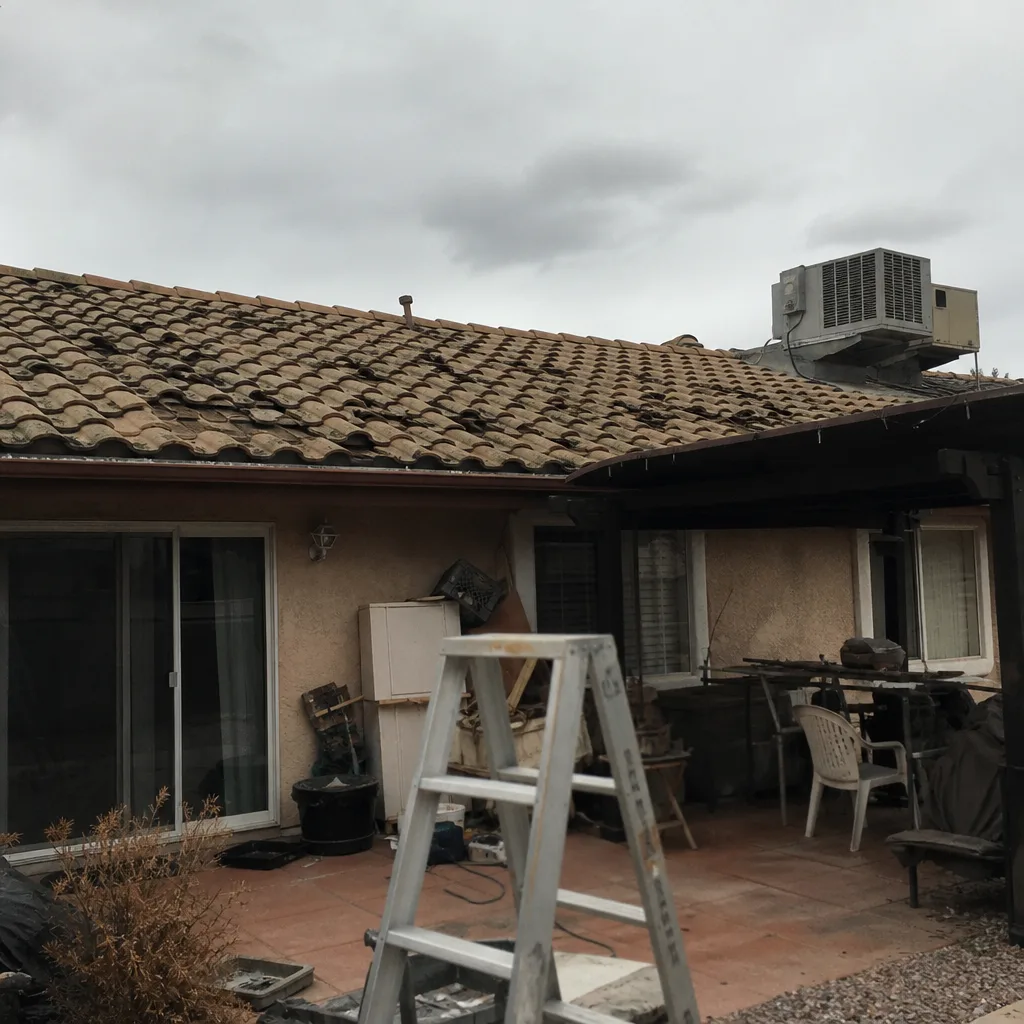 Before
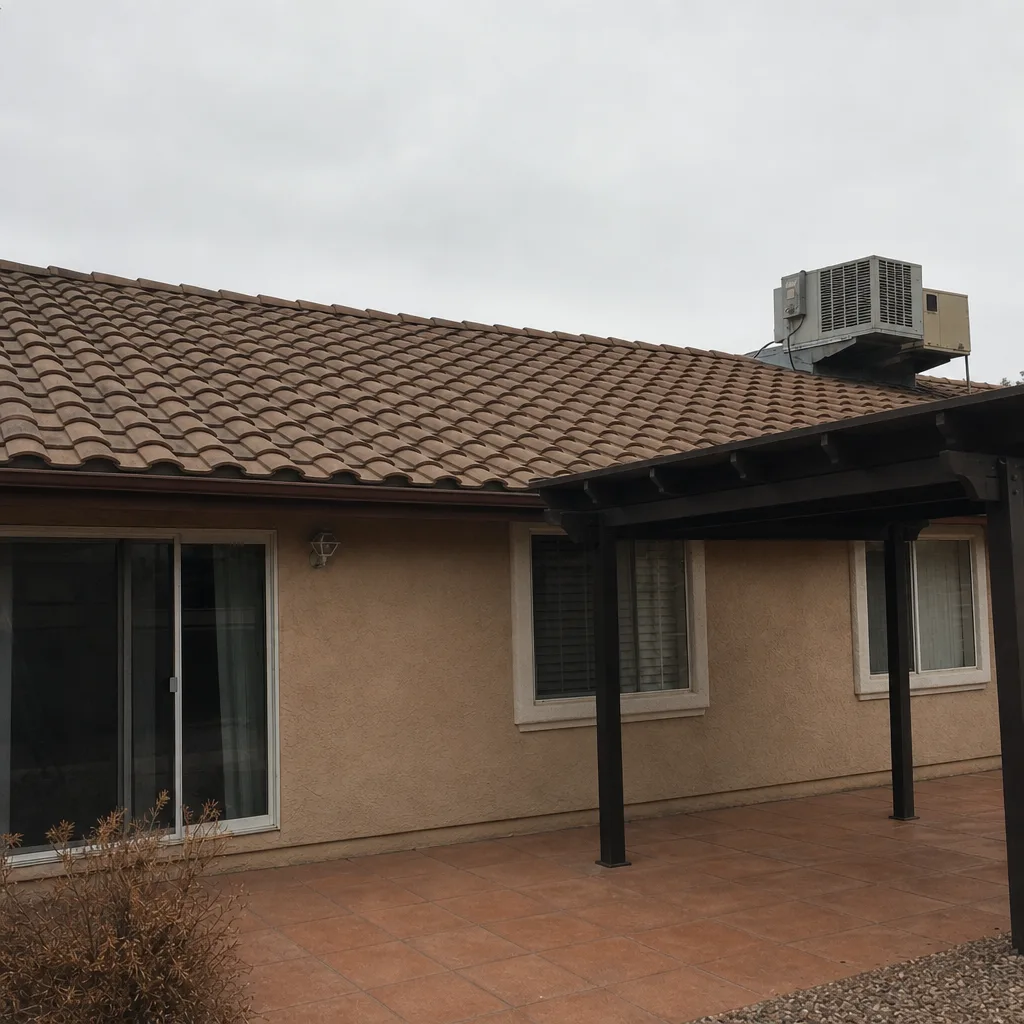 After
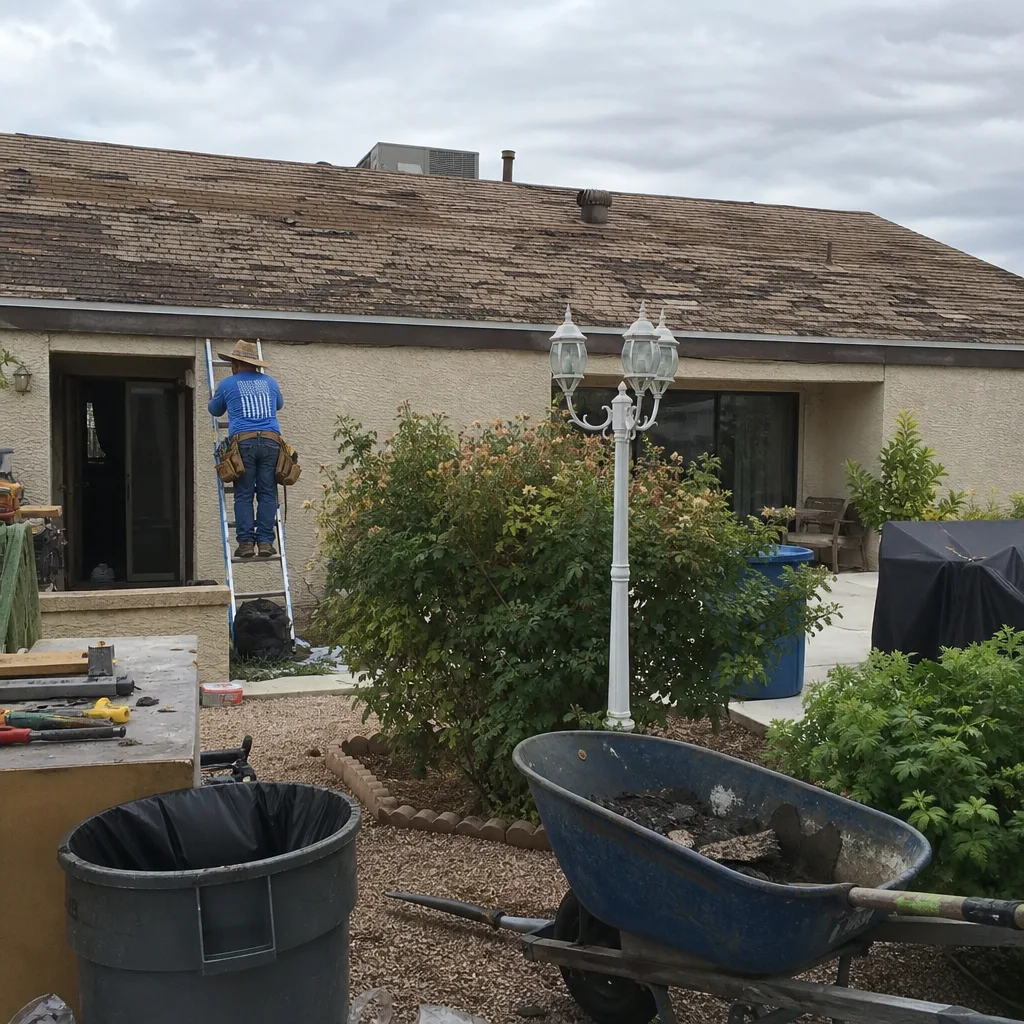 Before
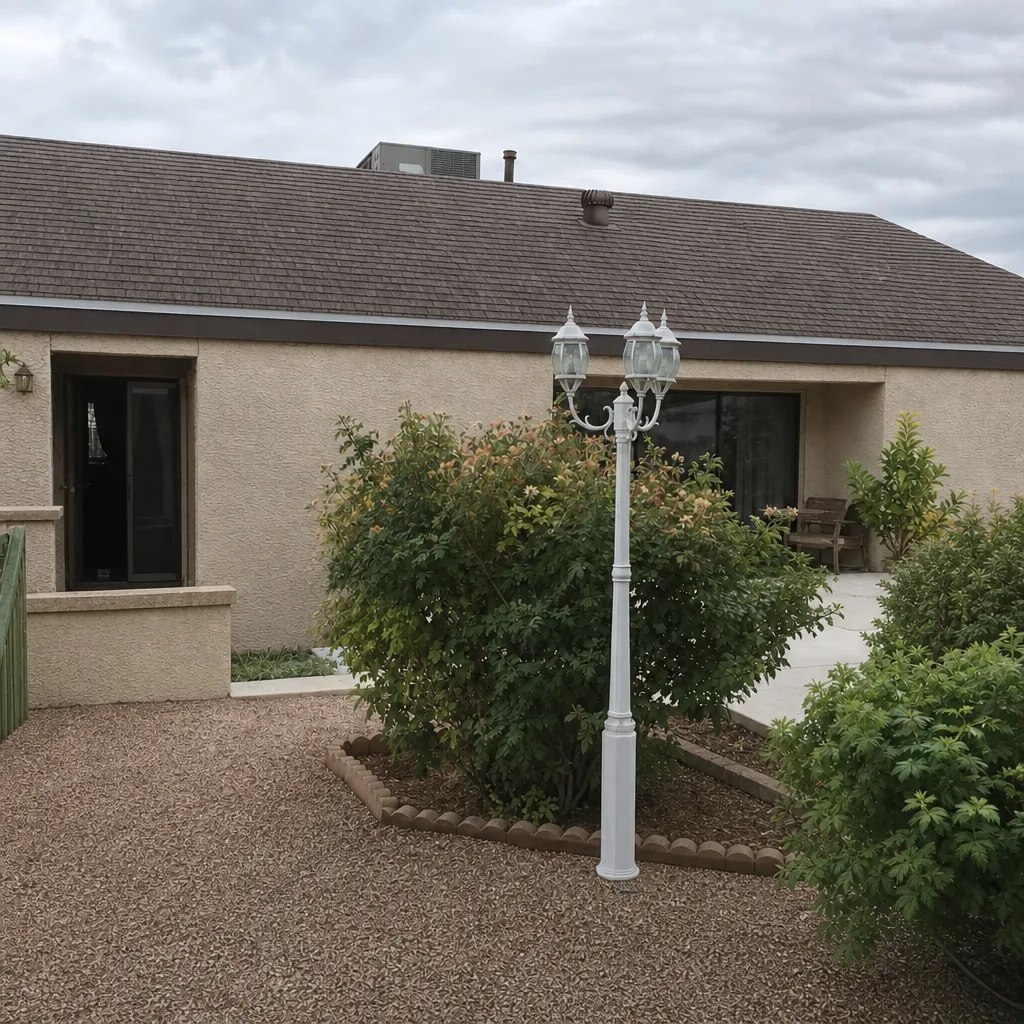 After
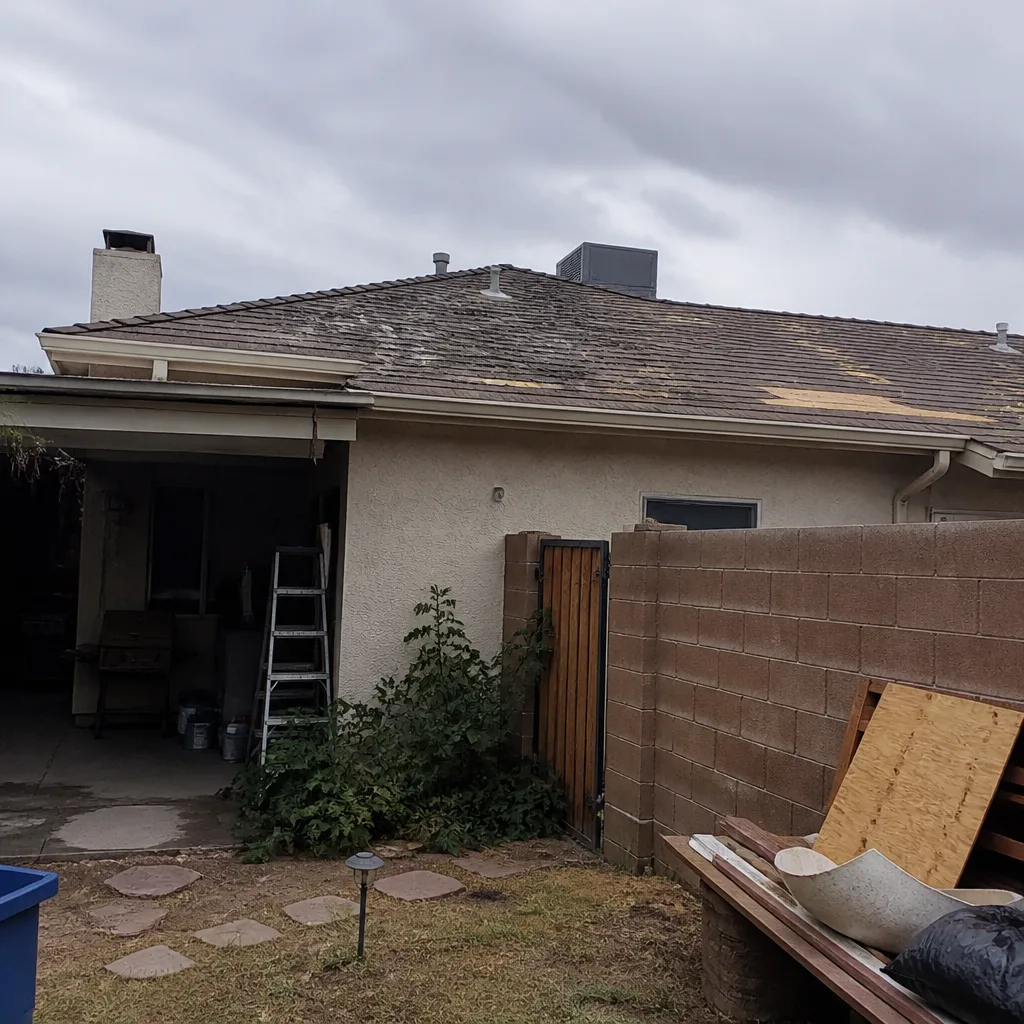 Before
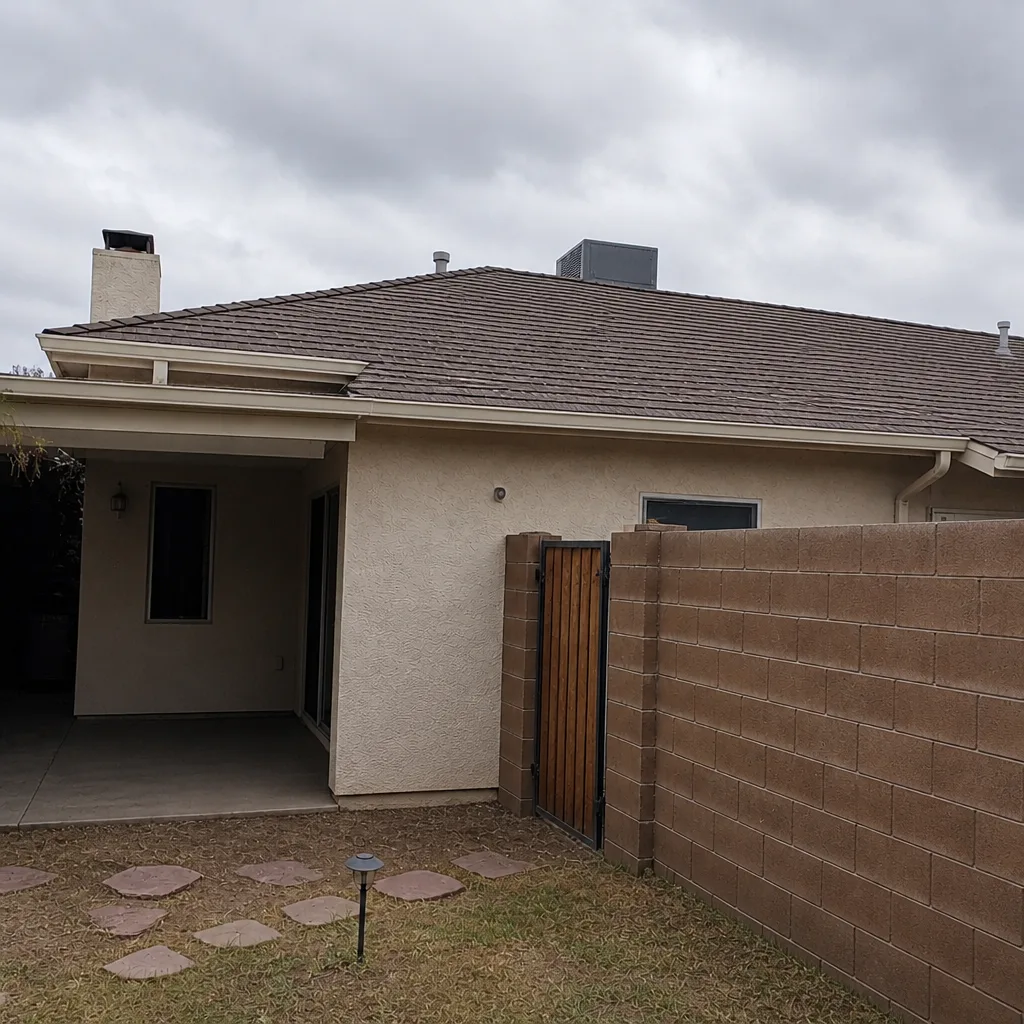 After
When to Call a Professional
Some gutter work is a homeowner task and some is not. Call a professional when a ladder is involved on a steep roof, when a hanger or spike is pulling away from soft fascia, when water is staining the fascia or the underside of the roof edge, or when a downspout will not drain despite clearing the elbow. Any sagging, any loose gutter run, or any sign of water finding its way inside is a call. We can also help if your roof edge and gutters are failing together and the fix needs to be planned as one job.
Ridgeline Roofing Co. Henderson offers free estimates in Henderson. Call (833) 691-6717 to schedule yours, and a live person will answer. Our team is background-checked, arrives in uniform, and documents what we find with photos taken from your actual roof. That is how we have done it since 1984.
Frequently Asked Questions
Twice a year for most homes: a thorough clean in late May or early June before the monsoon, and a reset in late September or October after it ends. If your home sits near open desert, a palm, or exposed west-facing roof, add a mid-summer visual check for dust and seam separation. Call (833) 691-6717 for a free estimate if you would rather have a trained technician inspect them.
Because monsoon rain arrives in short, heavy bursts from July through September, not gradually through autumn. Gutters need to be fully clear and sealed before that first storm. A fall-only schedule leaves the system unprepared when the rain actually comes. The pre-monsoon window is the one date that matters most. Call (833) 691-6717 to schedule a free estimate.
Yes. Fine desert dust settles into gutter troughs and packs into the elbows of downspouts, where rain alone will not move it. You may need to clear the elbow with a hand tool or snake before flushing. This is one reason we recommend checking downspouts during the post-monsoon reset. Call (833) 691-6717 for a free estimate on a full inspection.
They play a major role. The daily swings from hot afternoons to cool nights repeatedly expand and contract the metal spikes and ferrules that hold the gutter to the fascia. Over two or three seasons, those fasteners can work loose and the gutter will sag. A yearly hanger check catches them early. Call (833) 691-6717 for a free estimate.
They can help with larger debris such as palm fronds, seed pods, and roof grit, but they do not stop fine desert dust from settling in the trough and elbows. Clean and test the system first, then add a guard that fits your specific problem. Call (833) 691-6717 and we will give you a free estimate on the right solution.
Keep a dated, photographic record of your gutters and roof edge before the event. Take photos each season from the same angles, note the dates, and store them with your home records. That record shows the condition of the system before the storm. Call (833) 691-6717 for a free estimate on a photo-documented inspection.
The Bottom Line
Henderson gutters follow a calendar of their own. The most important date is late May or early June, before the monsoon, not autumn. After that, it is about defending the system against heat, dust, and daily temperature swings: check sealants on hot afternoons, clear the elbows with a hand tool when dust packs in, and re-tighten fasteners every few seasons. Keep a dated photo record so you can show what was in place before a storm. Done right, your gutters will hold up through burst after burst, and if it is not right, we make it right.
If you would like a trained set of eyes on your gutters and roof edge, call Ridgeline Roofing Co. Henderson at (833) 691-6717 for a free estimate. A live person answers every call, and the number on the estimate is the number on the invoice.
Written by the team at Ridgeline Roofing Co. Henderson.