
Last updated November 18, 2026
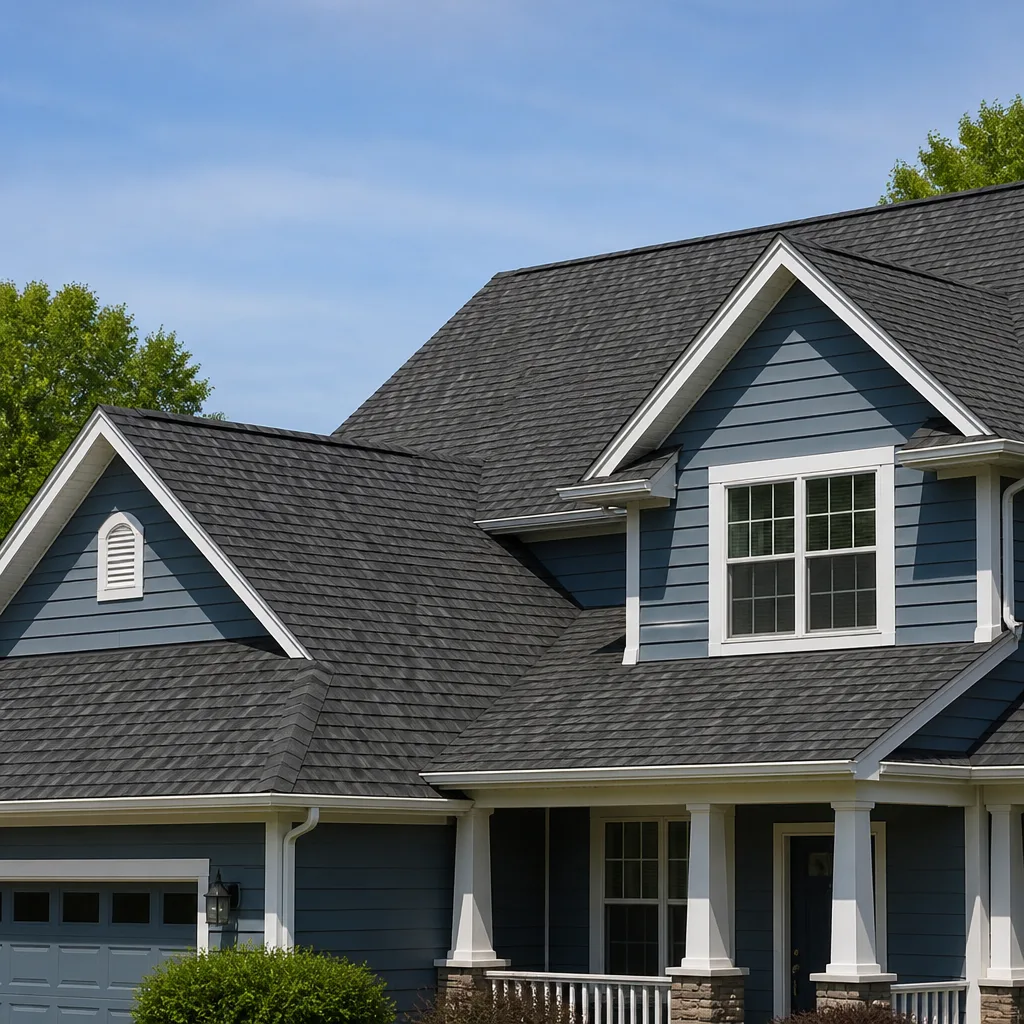 Architectural shingles
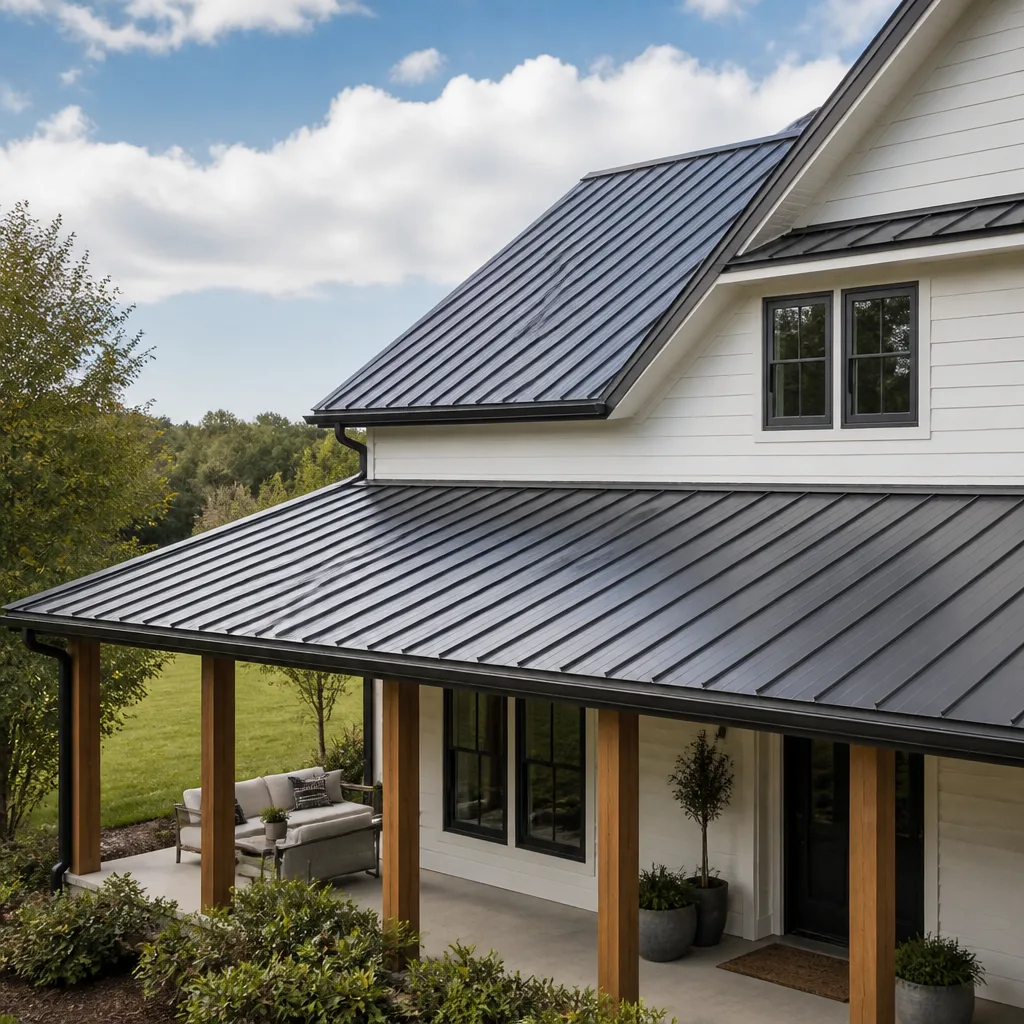 Metal roofing
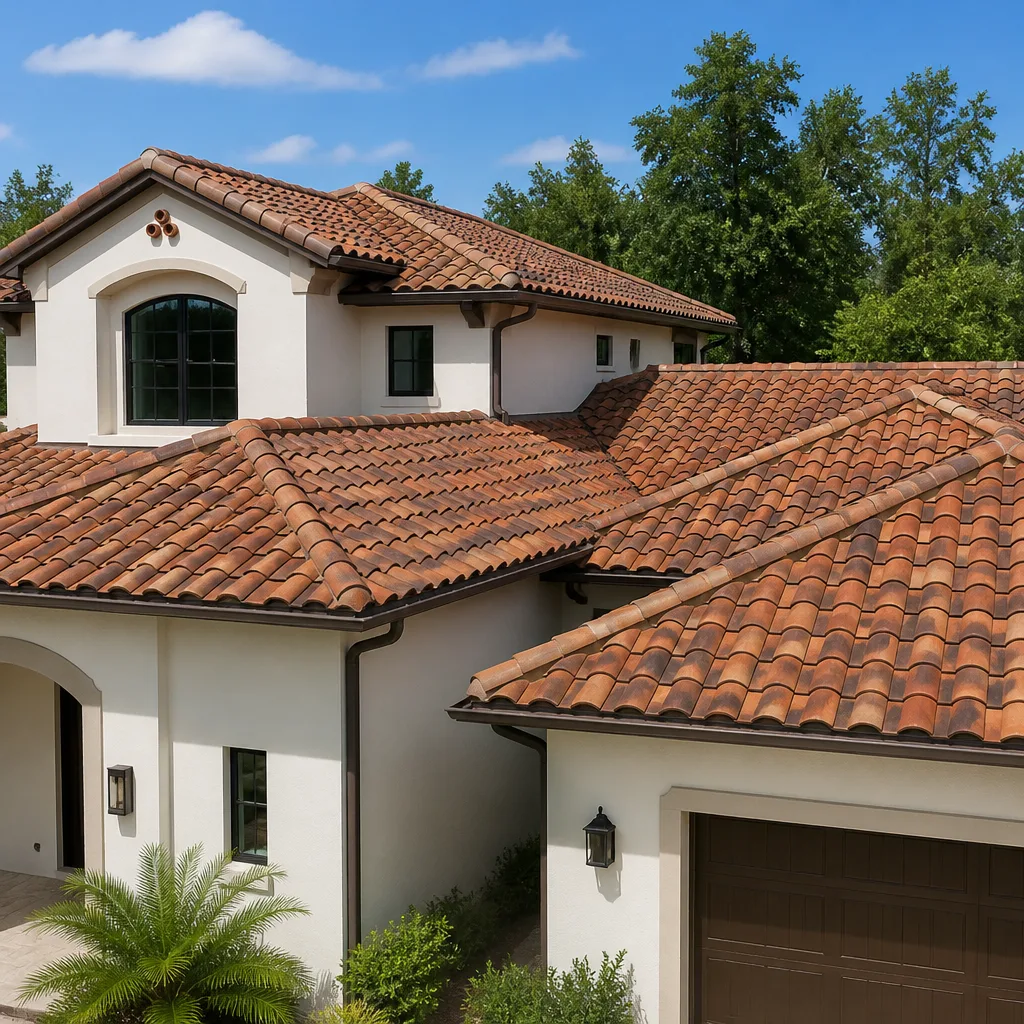 Tile roofing
 GAF
 Owens Corning
 Flat & low-slope
Free roof inspection with deck photos before we talk money - GAF and Owens Corning certified installation
The Complete Roof Repair Guide for Henderson Homeowners
Henderson averages 294 sunny days a year, and every one of them is slowly cooking the oils out of your roofing materials. Most national repair guides were written for climates that give your roof a break – a wet winter, a cloudy spring, a stretch of cool nights. Henderson doesn’t offer that. What it offers instead is UV load, caliche soil that moves, and a monsoon window that tests every repair you make. This guide covers how roof repairs actually behave in Henderson: what the heat does to shingles, why foundation shifts show up at your fascia first, and how to sequence a repair so it survives the July-September stretch.
Quick Answer
Roof repair in Henderson, NV typically runs $350 to $1,200 for localized damage and $1,200 to $3,500 for larger repairs spanning multiple slopes or involving flashing work. The repair should be planned around Henderson’s heat and monsoon cycle rather than done at the first sign of a problem, and materials should be UV-rated for desert exposure. Repairs done in the late spring, before the July-September monsoon, need extra attention to sealant cure time.
Styles & brands we work with
- Architectural shingles
- Metal roofing
- Tile roofing
- GAF
- Owens Corning
- Flat & low-slope
Table of Contents
- How Henderson’s UV and Heat Cycles Break Down Shingles
- Why Caliche Soil Telegraphs Problems Up to Your Flashing
- The Monsoon Window: Sequencing Roof Repairs in Henderson
- Reading Your Roof’s Age by Granule Loss, Not Install Date
- Repair Materials That Hold Up in Henderson Heat
- What Roof Repair Costs in Henderson
- What the 90-Day Done Right Promise Means in Practice
- Common Mistakes to Avoid
How Henderson’s UV and Heat Cycles Break Down Shingles
Asphalt shingles don’t fail from rain in Henderson. They fail from light. The UV index here sits high enough through most of the year that shingles lose their protective oils faster than in almost any climate except the deep desert south. The oils are what keep the asphalt pliable. Once they’re gone, the mat under the granules turns brittle and starts to crack at the stress points: ridge lines, valleys, and the perimeter where wind lifts the edges.
The daily swing matters as much as the peak. A Henderson roof can go from 60°F at dawn to 150°F surface temperature by early afternoon and back down again after sunset. That cycle repeats roughly 300 times a year. Each swing expands and contracts the shingle slightly. Ten years of those swings is 3,000 small movements, and the weakest shingles give out first.
What this means for a repair:
- Replacement shingles in Henderson should match the original for UV rating, not just color. A lighter shingle on a slope that faces west will outlast a dark one on the same slope by a measurable margin.
- Ridge caps fail before field shingles in Henderson because they get the most direct sun. A repair that skips the ridge cap will be back in two summers.
- West- and south-facing slopes need inspection more often than north-facing ones. If your roof is 15 years old and one slope faces west, that slope is likely two years further along than the rest.
If the damage is limited to one slope or one section, that’s a repair. If three slopes show the same UV pattern, the math starts favoring replacement. Our Roof Repair in Henderson page covers the threshold between the two in more detail.
Why Caliche Soil Telegraphs Problems Up to Your Flashing
Henderson sits on a lot of caliche – a calcium-carbonate hardpan that expands and contracts differently than ordinary soil. The layer doesn’t move much, but it moves. Over decades, foundation micro-shifts of a half-inch here and a quarter-inch there open gaps at the fascia and pull flashing away from the wall line. The shingles haven’t done anything wrong yet. The flashing has.
In our experience, the pattern shows up in specific places:
- Chimney flashing on homes built in the 1980s and 1990s in Green Valley and along the foothills – the chimney pulls slightly away from the wall as the soil shifts, and the lead flashing tears.
- Step flashing along dormers and sidewalls, where a millimeter gap lets monsoon rain track down the wall and into the attic before you see a stain on the ceiling.
- Fascia boards on the south and west sides, where wood dries out from heat and pulls away from the drip edge.
What makes this Henderson-specific is the timing. Caliche shifts often happen in the late spring when the soil dries fastest, and then the monsoon arrives and finds every gap that opened. A repair done in April without checking flashing is a repair that’s asked to hold through a hundred-year-old problem it never addressed.
Fixing this means opening the flashing, checking the substrate, and re-bedding with a sealant rated for desert temperature cycling. A shingle patched over torn flashing looks fine from the driveway and leaks by August.
The Monsoon Window: Sequencing Roof Repairs in Henderson
Henderson’s monsoon season runs roughly July through September, and it changes the way repairs should be scheduled. Two factors cause most of the failures we see:
- Sealants and adhesives need time to fully cure before they’re tested with standing water. A repair done on a Friday and hit by a monsoon cell on Tuesday may not have reached full bond.
- Sudden temperature drops before a monsoon cell compress the roof surface, and any repair that didn’t fully seat gets pulled apart as the surface returns to heat.
The sequencing that works in Henderson:
- Inspect in February through April. Catch UV damage and caliche-driven flashing gaps early, before the heat peaks.
- Repair in March through early June. This gives sealants 6-10 weeks to cure under real heat before the monsoon tests them.
- Hold non-critical repairs through the monsoon if the repair is cosmetic. A curled shingle on a north slope can wait until October. A flashing gap cannot.
- Post-monsoon inspection in October. Check every repair for lift, and check the flashing again – September storms are the ones that find the weak spots.
For anything critical that has to be done mid-monsoon, the repair needs to be scheduled around the 3-5 day dry windows. If you’ve already got a leak, our roof repair page has the specifics on getting one handled fast.
Reading Your Roof’s Age by Granule Loss, Not Install Date
The install date on the escrow paperwork is a starting point, not the answer. In Henderson, a roof’s real age shows in its granule pattern, and this is a more reliable field indicator than the paperwork – because sun exposure on a west slope will age shingles faster than the same shingles on the east side of the same house.
How to read it:
- Light granule loss (a few scattered bald spots): 5-8 years of real Henderson UV exposure. This roof has plenty of life left.
- Bare mat showing in valleys and on ridge caps: 10-13 years. Repair territory, not replacement yet – but don’t skip two summers of inspection.
- Widespread bald patches on the south and west slopes, granules in the gutters after every rain: 15+ years. That roof has done its job. Repairs start costing more than the roof they’re preserving.
- Lifted tabs across multiple slopes: this is a wind-plus-thermal-failure signal, not just age. The underlayment is likely exposed.
The granule check takes ten minutes from the ground and a ladder, and it tells you more than any document. If the granule pattern varies wildly across slopes on the same roof, that’s the local flag – it means UV is eating one side faster, and any repair should focus there.
Repair Materials That Hold Up in Henderson Heat
Materials that work in coastal or northern climates don’t all work here. Sealant that’s fine in a Seattle repair can fail in the first Henderson summer because the surface temperature of a dark shingle pushes past the sealant’s rated range. SBS-modified materials hold better than standard asphalt in high-UV, high-cycle climates, and that’s the general direction to look for.
What we recommend for Henderson repairs:
- Shingles: architectural shingles rated for high-UV exposure. We’re an authorized installer of GAF, CertainTeed, Owens Corning, IKO, Atlas, Tamko, and Boral, and for repairs we match the existing line wherever possible rather than substituting.
- Flashing: metal flashing over lead in most Henderson applications – it takes the thermal cycling better and doesn’t deform as easily in the heat.
- Sealants: polyurethane or high-performance SBS sealants rated to 200°F+ surface temperature. Standard roofing caulk is a six-month patch here.
- Underlayment: synthetic underlayment where any underlayment is exposed, since felt breaks down faster under UV.
When the material is right and the sequencing is right, most repairs in Henderson hold for the remainder of the roof’s life. When one of those is wrong, the repair is back in 18 months and you’ve spent money twice.
What Roof Repair Costs in Henderson
Cost varies with the size of the repair, the material match, and whether the repair is a simple shingle swap or involves flashing and fascia work. Here’s what we see in the Henderson market:
| Repair type | Typical range |
|---|---|
| Single shingle or small patch (under 10 sq ft) | $350 – $650 |
| Larger repair (10-50 sq ft, one slope) | $650 – $1,500 |
| Flashing repair (chimney, sidewall, or step) | $450 – $1,200 |
| Multi-slope repair | $1,500 – $3,500 |
| Fascia and soffit repair | $400 – $1,800 |
| Emergency tarp and stabilization | $250 – $800 |
Two things drive cost up in Henderson more than elsewhere: matching an older shingle line so the repair blends, and finding caliche-driven flashing damage that didn’t show on the original estimate. On the second point, a written line-item quote should flag that the flashings may reveal additional work once opened – and any honest quote will tell you that number in advance.
The number on the estimate should be the number on the invoice. If a repair estimate doesn’t have line items, ask for one.
What the 90-Day Done Right Promise Means in Practice
A repair that isn’t tested isn’t really a repair – it’s a hope. The 90-Day Done Right Promise is a written workmanship guarantee, and the value is in the checkpoints behind it. Here’s what the promise looks like after a Henderson repair:
- Photo document every stage. Before, during, and after – from the actual roof, not the driveway. These are your record if anything shifts.
- Checkpoint 1: the day of the repair. Confirm adhesion, seal, and flashing seating. Look for any caliche-driven gap that opened while the work was underway.
- Checkpoint 2: within two weeks. A follow-up inspection after the repair has seen a full heat cycle. This catches any shingle that lifted or sealant that didn’t bond fully.
- Checkpoint 3: at 60-90 days. A final inspection to confirm the repair held through at least one extended heat stretch. This is the checkpoint that matters most in Henderson, because a repair that fails under sustained heat is one that was never going to make it through a monsoon.
If any checkpoint shows a problem, we come back and make it right. No arguing, no paperwork. That’s the whole point of a written guarantee: the work has to hold, and if it doesn’t, the company that did it carries the cost. Not a storm-chasing outfit – a company that’s going to be here next summer to honor the guarantee. We’ve built the business on that for over 42 years, and hires that get trained into journeymen because the crews aren’t going anywhere.
If any part of this repair picture points to a bigger job – which the granule pattern sometimes does – our Roof Replacement & Installation in Henderson page covers what the transition looks like. For roofs with unusual architectural shapes, Specialty Roofing in Henderson covers the flat, low-slope, and tile work that doesn’t fall into standard shingle repair. And for a look at the whole lineup, Ridgeline Roofing Co. Henderson home is the place to start.
Common Mistakes to Avoid
- Patching the shingle and skipping the flashing. In Henderson, the flashing is often the actual failure. A patched shingle over torn flashing looks fixed and leaks again by monsoon.
- Repairing in late June without checking sealant cure time. A repair made the day before a monsoon cell hits may not have fully bonded, and it will show as a leak the following season – not this one.
- Reading age from the install date only. Slope-by-slope granule inspection tells you what the paperwork can’t. A west-facing slope at year 12 is often worse than an east-facing slope at year 18.
- Using standard roofing caulk on Henderson heat. The surface temperature on a dark shingle can push past standard caulk’s rated range. The repair won’t hold.
- Ignoring caliche-driven fascia separation. Wait a season and the fascia pulls further, taking the drip edge with it.
- Hiring a storm-chasing crew after a monsoon event. They quote low, do the repair, and leave. The repair has no written guarantee – and there’s no one to call in May when it fails.
- Skipping the post-repair follow-up. A repair that isn’t checked after one full heat cycle isn’t verified. It’s a guess.
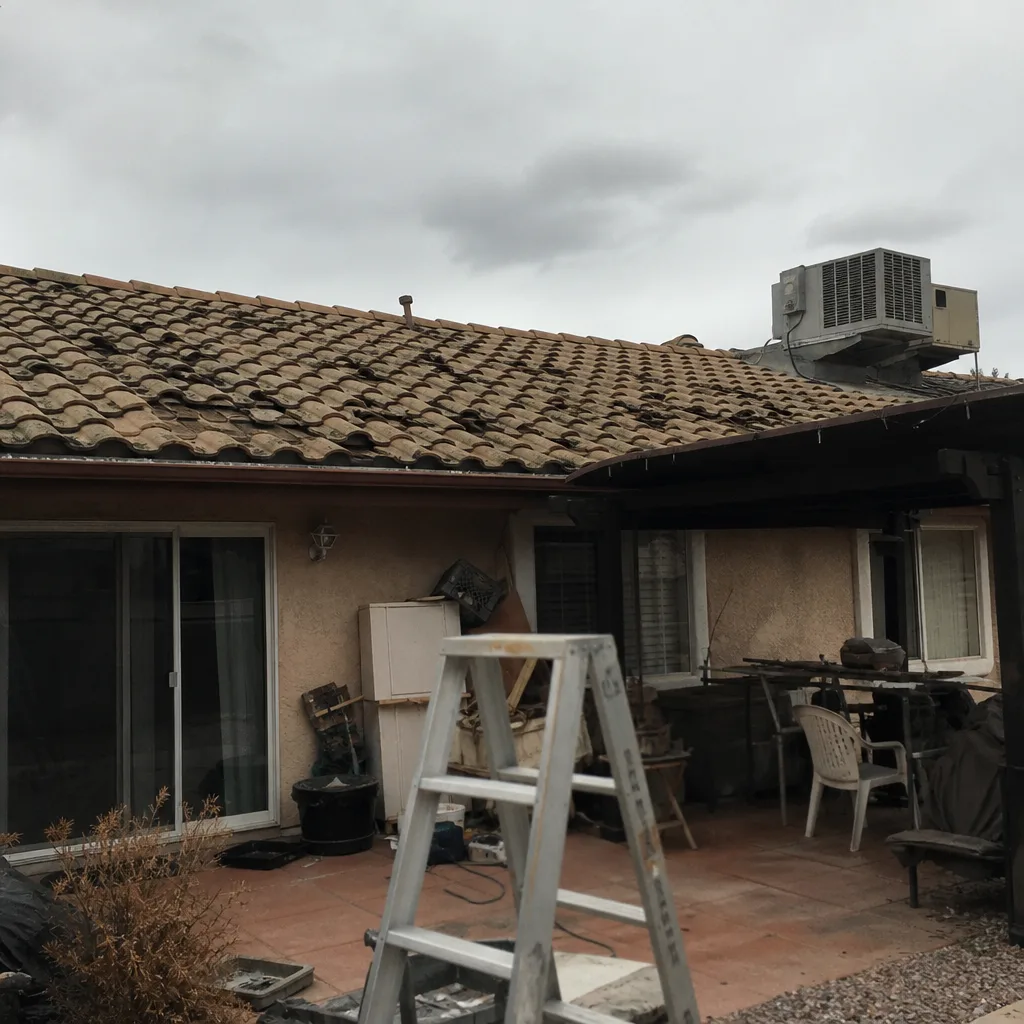
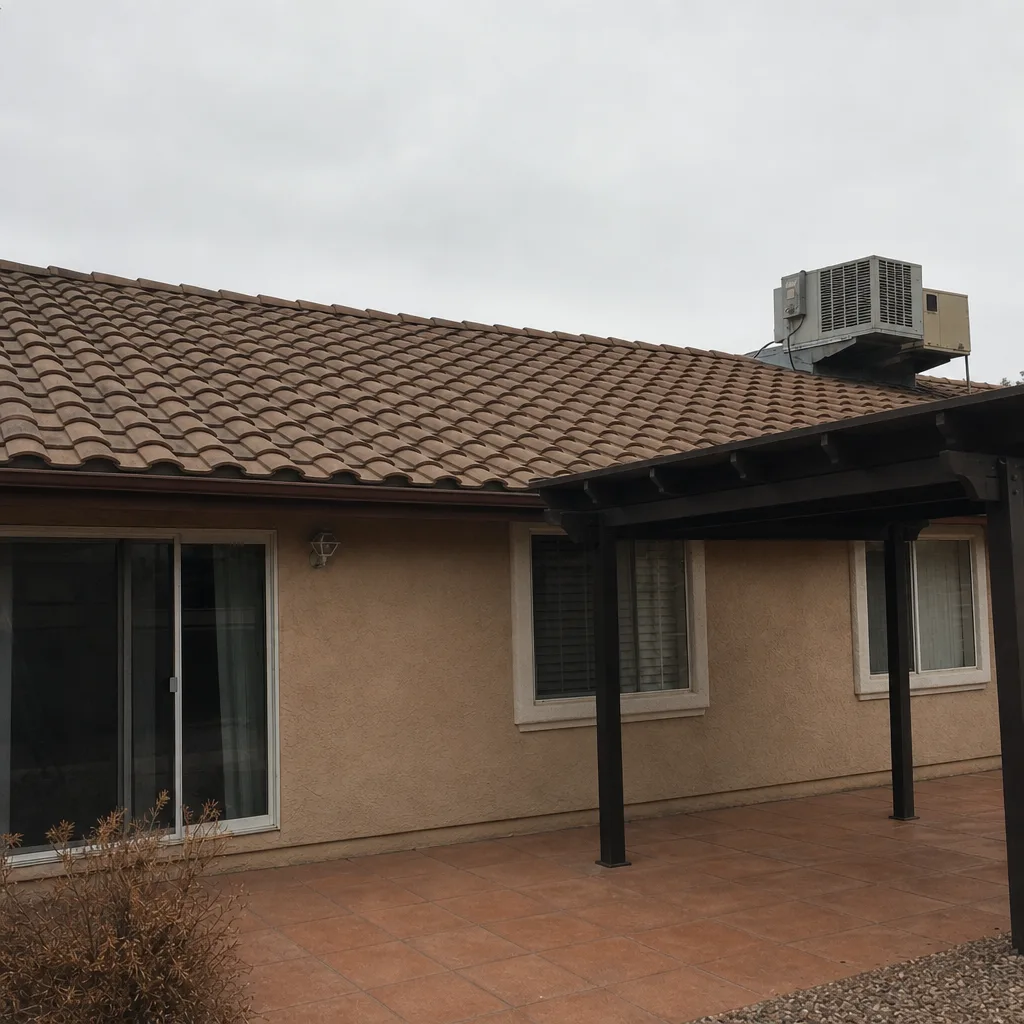
See the difference
 Before
 After
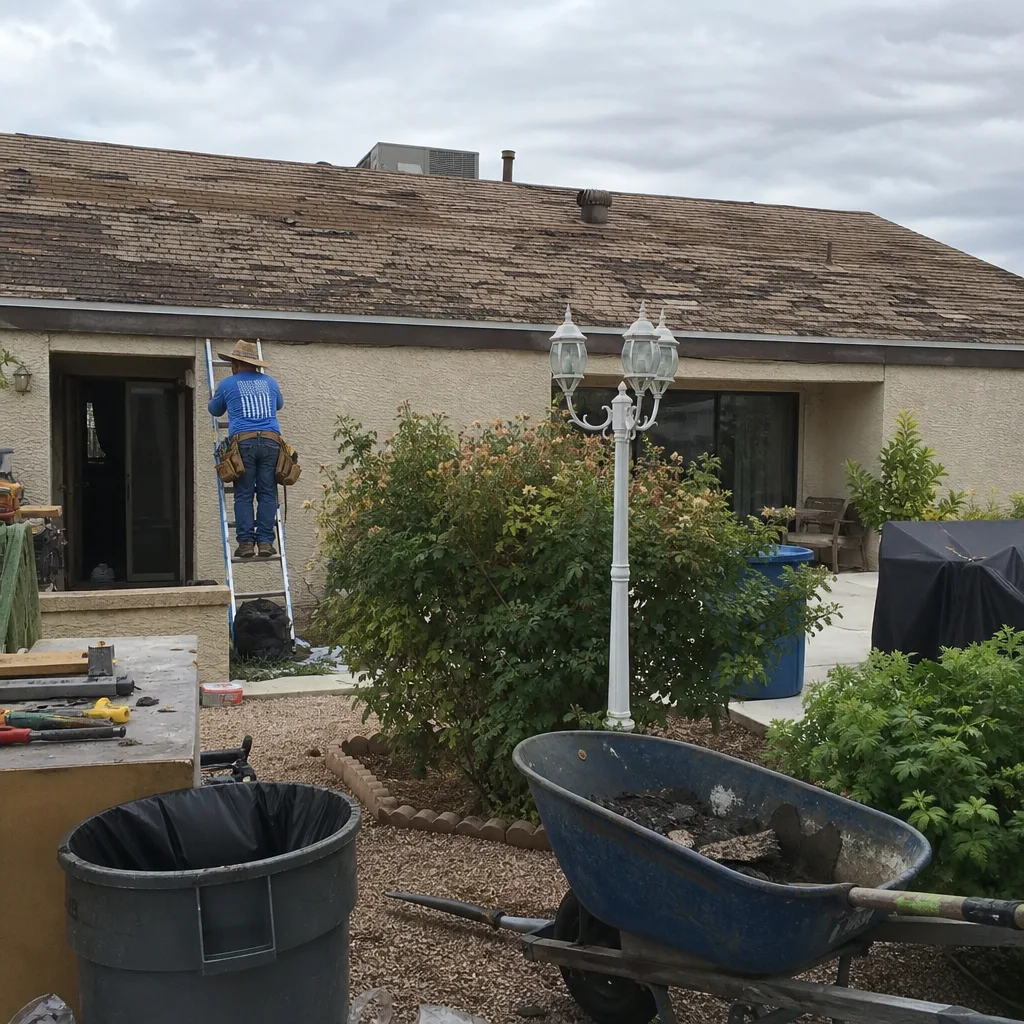 Before
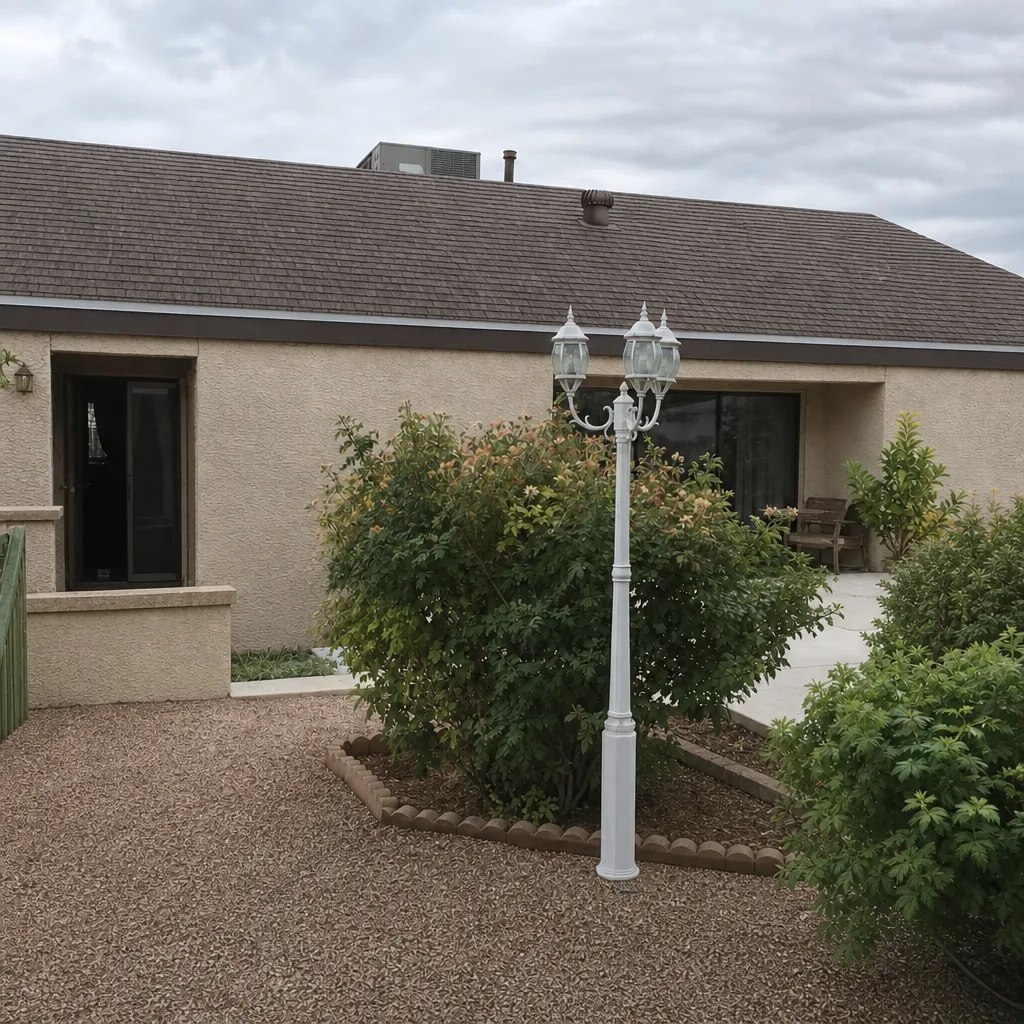 After
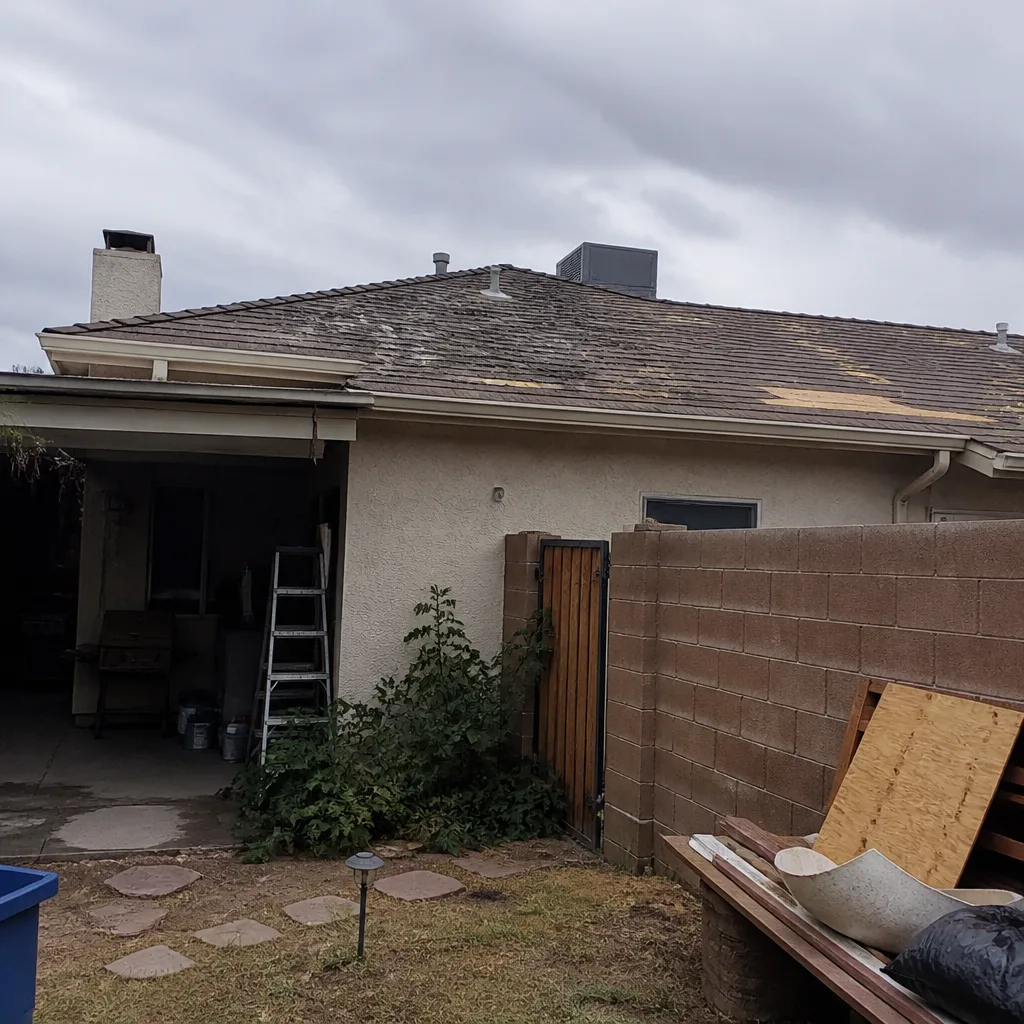 Before
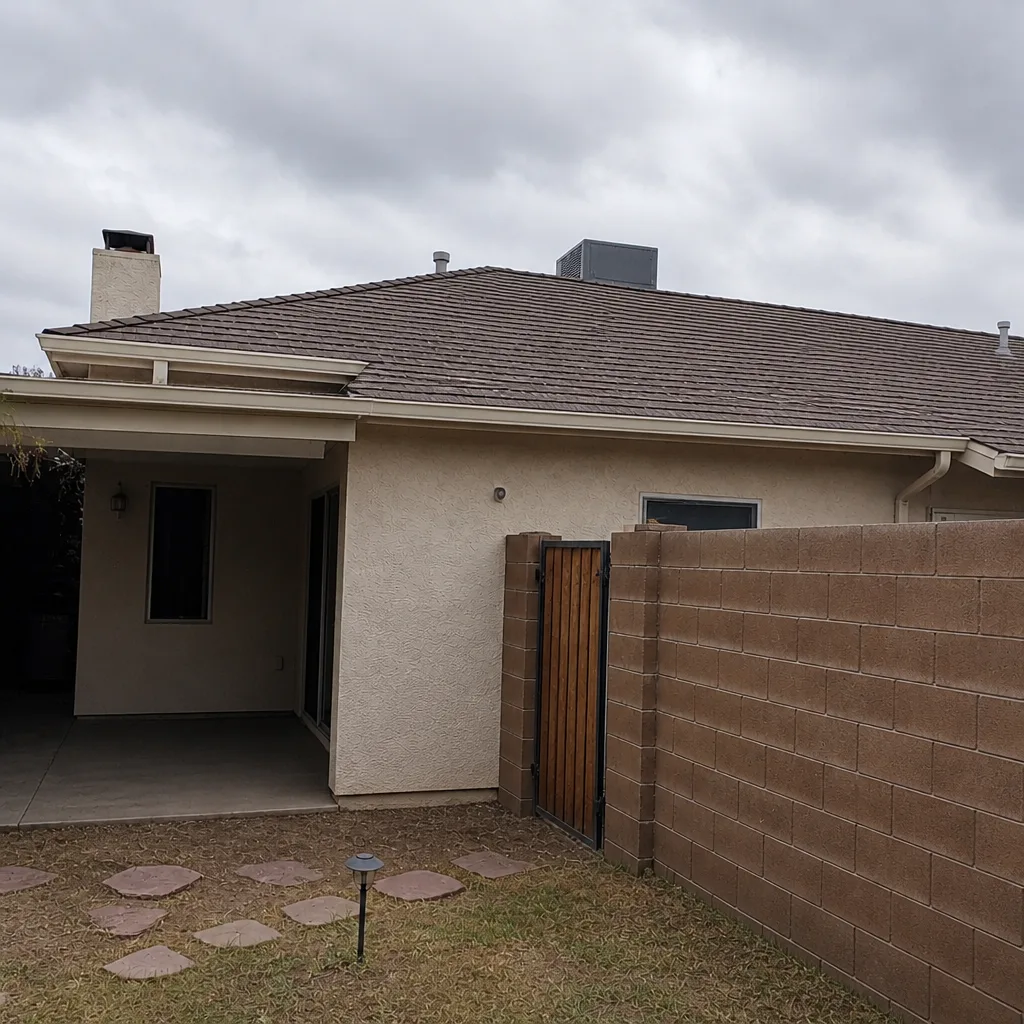 After
When to Call a Professional
Some repairs are simple enough to glance at from the ground and understand – a missing shingle after a wind event, a granule trail in the gutter. But roof work on a two-story Henderson home, in summer heat, with caliche-shifted flashing that has to be opened and re-bedded, is not a homeowner project. The scenarios that should stop you: any leak showing through the ceiling, flashing pulled from the wall line, a sagging roofline, widespread granule loss on a west or south slope, or a storm that lifted shingles across more than one slope. Working on a steep or high roof is a genuine safety risk, and the most useful thing a homeowner can do is get the right eyes on it from the ground up. Ridgeline Roofing Co. Henderson offers free estimates in Henderson – call (833) 691-6717 and a live person will answer, day or night, including during a storm.
Frequently Asked Questions
Most roof repairs in Henderson run between $350 and $3,500 depending on the size and whether flashing is involved. Single patches are $350-$650, larger single-slope repairs are $650-$1,500, and multi-slope work runs $1,500-$3,500. The line-item quote you get should include every cost, with no change-order surprises. Call (833) 691-6717 for an exact quote – estimates are free.
UV intensity and the daily heat cycle are the main culprits. Henderson gets roughly 294 sunny days a year, and each day pushes a roof surface from 60°F to 150°F and back again. That cycle strips shingles of their oils faster than in wet or cloudy climates. Caliche soil movement adds a second layer of stress by opening flashing gaps. A repair that accounts for both lasts; a repair that ignores one will come back.
On a properly quoted repair, no. A written line-item quote includes the number for each part of the job, including the possibility of finding more flashing damage than the original inspection showed. If the flashing turns out worse than the photo showed, you should be told the number before the work continues. The number on the estimate is the number on the invoice.
Repair makes sense when damage is limited to one slope or one section. Replacement becomes the better math when three or more slopes show granule loss, when repairs would total more than 25% of a replacement, or when the roof is 15+ years old with widespread bald spots. The granule pattern – not the install date – is the deciding factor.
Yes. We work across Henderson, including Green Valley, Anthem, the foothill neighborhoods along the McCullough Range, and the south Henderson areas near Lake Mead Parkway. Caliche patterns vary a bit by neighborhood, and inspection always starts with a local look at your slope orientation and soil conditions. Call (833) 691-6717 to schedule a free estimate.
A properly done repair should hold for the remainder of the roof’s life – typically another 5-10 years on a roof in good shape. The variables are material match, whether flashing was properly addressed, and how the repair is sequenced against the monsoon. The 90-Day Done Right Promise exists because materials and method don’t always do what they should – and if the repair fails in that window, we come back and make it right.
The Bottom Line
Roof repair in Henderson is a different job than roof repair anywhere else. UV load strips shingles of their oils at a rate most guides don’t account for, and caliche-driven foundation movement telegraphs up into flashing before the shingles ever show damage. Read your roof by its granule pattern, not the install date. Schedule the repair between March and early June so it has time to cure before the monsoon tests it. Match materials to Henderson heat, and insist on a quote that includes what the flashing might reveal. And when the granule pattern says the repair is chasing a bigger job, get an honest assessment before you spend twice.
Contact
If you’re looking at your roof and not sure whether it’s a repair or something larger, call (833) 691-6717 for a free estimate. A live person answers every call, day or night. We’ll show you the photos before we talk about a price, and if a repair will do the job, that’s what you’ll hear. Standing offers include $50 off any repair over $250, a free second opinion on any written estimate, an $89 seasonal tune-up, and a permanent 5% senior and veteran discount. Ridgeline Roofing Co. Henderson is your anti-storm-chaser – done right, and if it’s not, we make it right.
Written by the team at Ridgeline Roofing Co. Henderson.